
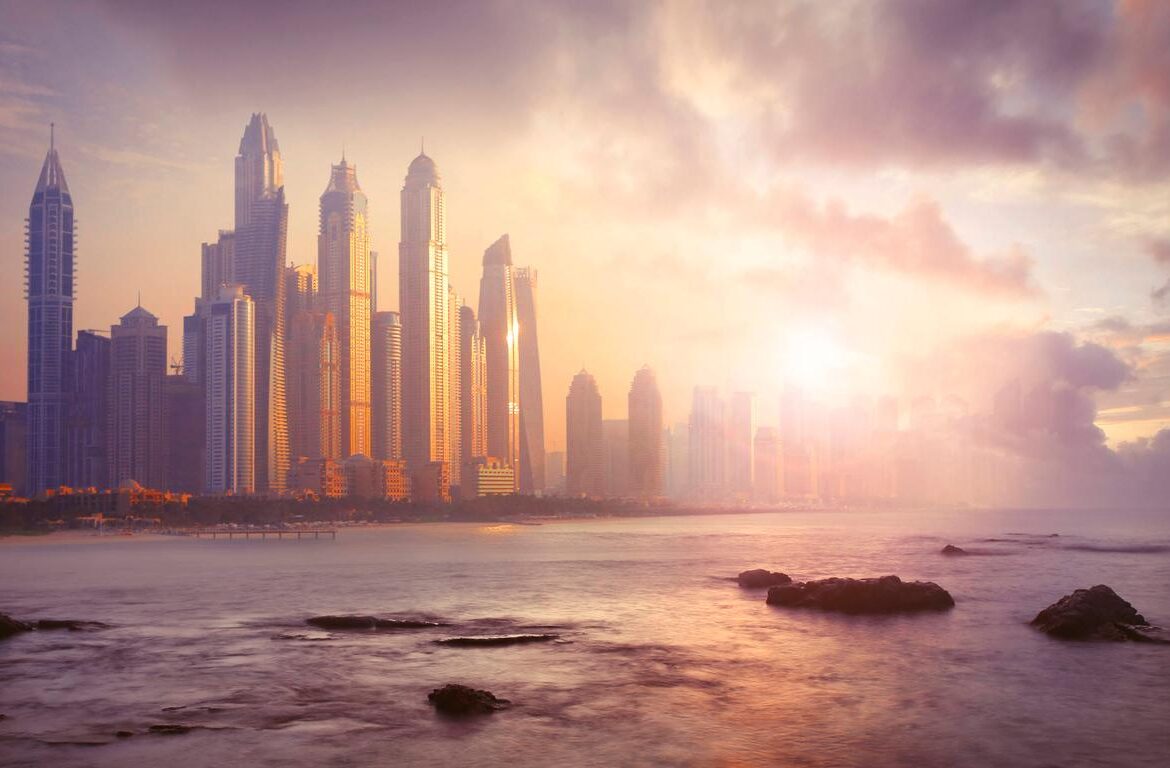

Dubai is the rare long-haul city where the whole trip can happen inside a twenty-minute radius: a private beach on the Palm in the morning, a Michelin table in the financial district at eight, the desert an hour out when you want the opposite of all of it. That compression is the real luxury, and it is why our Dubai villas sit on Palm Jumeirah — the one address that puts beach, city and airport within half an hour of each other.
Below is when to come, where to stay, where to eat, and the nine houses themselves — with what they actually cost.
01When to go
Dubai has one season for visitors and it is generous: mid-October to late April. Outside it, high summer is genuinely punishing — 42°C and humid — and is spent indoors. The trade-off is straightforward: the best weather and the highest rates arrive together.
Ramadan runs from about 8 February to 8 or 9 March 2027, with Eid al-Fitr on 9 or 10 March — the UAE confirms both by moon sighting, so treat them as planning dates. Note this puts Ramadan inside the February–March weather window, and the Eid public holiday runs three to four days after it. Daytime dining is restricted, the city runs quieter and slower, and evenings are extraordinary; some guests choose it deliberately. The Dubai Shopping Festival runs from December into late January, which is part of why that window is the busiest.
02Getting there
Dubai International (DXB) is one of the busiest airports on earth and the one you want — it is about twenty-five minutes from Palm Jumeirah. Nonstops run from New York in roughly twelve to thirteen hours and from the West Coast in about sixteen. Al Maktoum International (DWC), in the Dubai South development to the south, is used mainly by low-cost carriers and sits considerably further from the beach addresses — worth knowing if a booking engine routes you there.
Arriving by road from Oman or Saudi Arabia is straightforward for GCC residents, and the Hatta and Al Ain crossings put the Hajar Mountains within reach for a day. Cruise arrivals come in at Mina Rashid. Most guests fly.
We arrange the private aviation and airport concierge end to end when that is the right answer — aircraft and crew, clearances, fast-track at both ends, and the car timed to the actual arrival rather than the schedule. One of our Palm properties includes private DXB or DWC transfers in the rate.
03Where to stay
The honest version: in Dubai the neighbourhood decides the holiday more than the building does, and for a private villa there is really one answer, with three alternatives worth knowing.
Palm Jumeirah — where the villas are
The Palm is a palm-shaped island attached to the mainland, several kilometres from trunk to crown, with Atlantis at the far end. It matters for one structural reason: it is the only part of Dubai with a real stock of detached villas on private beach, most of them on the fronds, each with its own stretch of sand and a pool. Twenty-five minutes to DXB, ten to Dubai Marina, twenty to Downtown.
Downtown
The Burj Khalifa, the Dubai Mall, the fountain, the restaurants everyone has heard of. It is the reason Dubai is famous and the right base for a short first visit built around the city rather than the water — but it is apartments and hotels, not villas, and there is no beach.
Dubai Marina and JBR
The most walkable part of the city: a beach, a promenade, a canal ringed by towers, and more restaurants per square metre than anywhere else. Relaxed, international, good for groups who want to leave the house on foot. Again, towers rather than villas.
Jumeirah and Al Sufouh
The older low-rise beach suburbs along the coast, between the Marina and the creek — quieter, more residential, closer to Burj Al Arab and the Madinat. A villa here comes up occasionally; none of the houses listed below is in this area today.
04Our nine Dubai villas
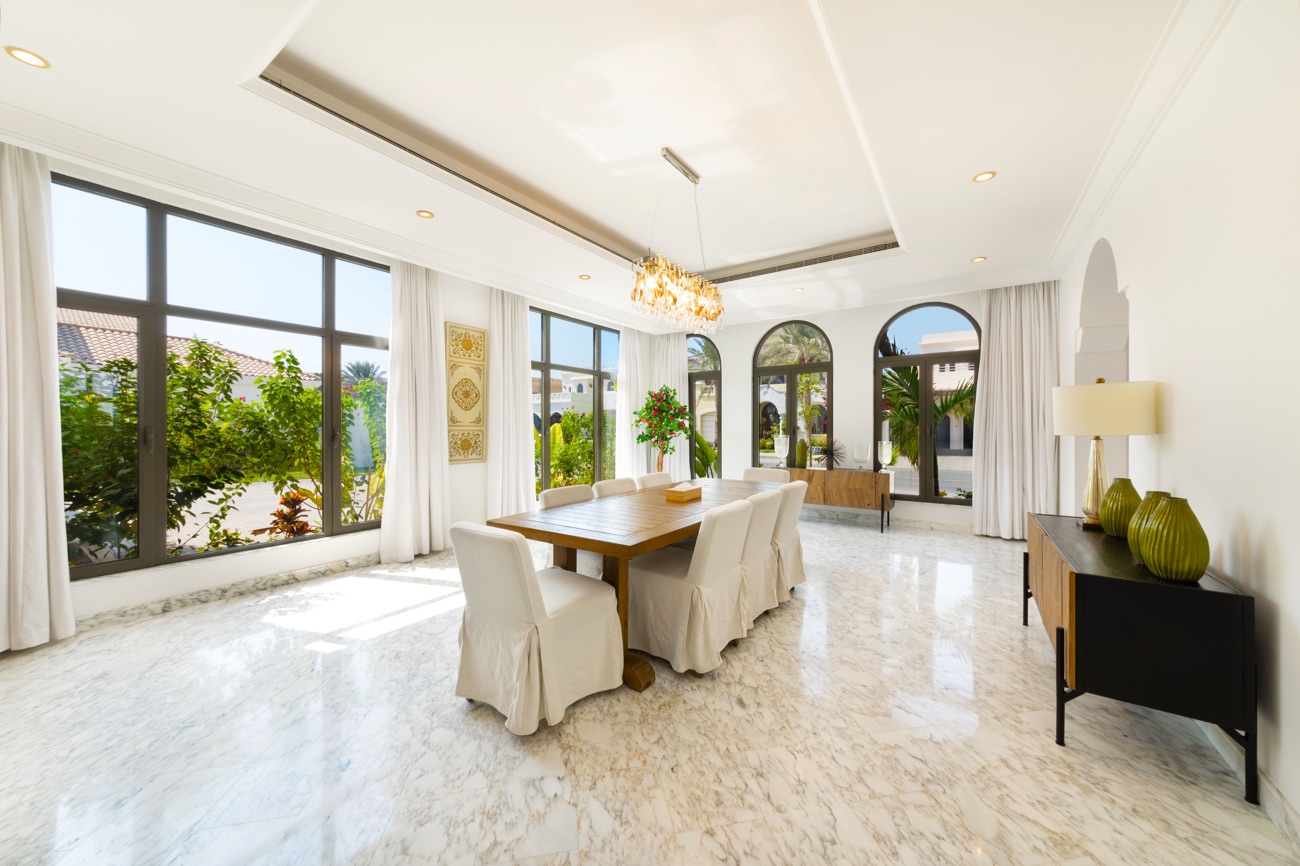
Every figure below is from the villa’s own listing. Five are already tagged for Christmas and New Year 2026/27, which in Dubai is the week that goes first.
05Where to eat
Dubai’s dining is genuinely world-class and unusually varied — a consequence of a city where most residents come from somewhere else. Four that are worth planning around:
Al Mahara, Burj Al Arab
The room is the reason: a seafood restaurant wrapped around a floor-to-ceiling aquarium, reached through a theatrical mock-submarine corridor. It should be too much and is not. Book well ahead; ask for a table on the waterfront terrace if the season allows. jumeirah.com
La Petite Maison, DIFC
Niçoise cooking in the financial district, and the most reliably good lunch in Dubai — artichokes, courgettes, burrata, whole fish, nothing complicated done very well. Loud, busy, the room everyone in the city passes through. lpmrestaurants.com
Eauzone, One&Only Royal Mirage
Built out over the water on a series of decks, so it reads as floating. Barefoot and slow by day, properly smart after sunset. The best-sited dinner on the old Jumeirah coast. oneandonlyresorts.com
Al Hadheerah, Bab Al Shams
An hour out of the city among the dunes: fourteen live cooking stations, Emirati and Levantine food, dinner under the stars with falconry and Bedouin music. The one place on this list that is an evening rather than a meal, and the right call for a group. babalshams.com
The tables above book out two to four weeks ahead in high season, and over the festive fortnight considerably further. Your specialist holds them alongside the villa — along with a private chef at the house, which for a group of twelve is usually the better evening anyway.

06What to actually do
- Burj Khalifa — 828 metres, 163 floors, observation decks on 124/125 and 148. Book a timed slot online; the queue on the door is the whole experience ruined. The fountain show below runs free every half hour after dark.
- Burj Al Arab — the sail on its own artificial island, 321 metres. You cannot wander in; go for lunch, dinner or the tour.
- A desert evening — dune drive, camels and a Bedouin-camp dinner, or the quieter version: a dawn hot-air balloon over the Dubai Desert Conservation Reserve with breakfast on landing. We arrange both privately rather than on a shared coach.
- Jumeirah Mosque — the one mosque in Dubai that welcomes non-Muslim visitors on guided tours, run by the Sheikh Mohammed Centre for Cultural Understanding. Genuinely worth an hour.
- Al Fahidi and the creek — the 19th-century merchants’ quarter of coral and limestone wind-tower houses, the spice and gold souks across the water, and the abra boats that still ferry people over for a coin. The oldest thing in the city and the best counterweight to the rest of it.
- Aquaventure at Atlantis — the waterpark, and the single most effective way to spend a day with children. Ten minutes from the Palm villas.
- A day on the water — a chartered yacht out of Dubai Marina, which is the only way to see the skyline the way it was designed to be seen.
07Questions we get asked
When is the best time to visit Dubai?
Mid-October to late April. February and March are arguably the best of it — warm, dry and quieter than the December peak. One caveat for 2027: Ramadan covers roughly 8 February to 9 March, so if you want that weather without the daytime restrictions, the second half of March, or late October to January, is the better aim. December and early January are the most expensive weeks of the year, and high summer, June to September, is 42°C and spent indoors.
Where should I stay in Dubai for a private villa?
Palm Jumeirah, effectively. It is the only part of the city with a real stock of detached villas on private beach, and the villa table above lists what is on it, with bedrooms, capacity and rate. It is twenty-five minutes from the airport, ten from Dubai Marina, twenty from Downtown. Downtown, the Marina and JBR are towers and hotels rather than villas.
What does a Dubai villa cost?
Our Palm Jumeirah houses start from around $780 a night for five bedrooms and $1,307 for a four-bedroom with a higher specification — both far less per person than equivalent resort suites once a group is eight or more. Rates rise sharply over Christmas and New Year, which is booked twelve months ahead at the best houses.
Are there taxes on top of the nightly rate?
Two, and neither is in the quoted figure. Dubai collects a Tourism Dirham of 10 AED per bedroom per night — about $4 — usually on arrival, and all bookings carry 5% UAE government VAT. On a seven-bedroom villa for a week the Tourism Dirham comes to roughly $200. Small against the rate, but worth knowing before you arrive.
Do the villas come staffed?
It varies by house, and it is worth asking specifically. The Jumeirah Zabeel Saray residences include a private butler, daily housekeeping, buffet breakfast and complimentary private transfers to and from DXB or DWC. Elsewhere we arrange staffing, a private chef and provisioning to the brief.
What should I know about visiting during Ramadan?
In 2027 Ramadan runs from about 8 February to 8 or 9 March, with Eid al-Fitr on 9 or 10 March; the UAE confirms both by moon sighting. That matters if you are booking for the weather, because it covers most of February — the month we would otherwise send you to. Daytime eating and drinking in public are restricted, the pace of the city slows, and the evenings after iftar are among the most memorable times to be there. Villas, pools and private dining are unaffected.
Next: see all nine houses on the Dubai villas page, or browse the full collection of 83 destinations.
A specialist will come back within 24 hours with two or three Palm Jumeirah villas matched to your group, the staffing and chef options for each, and the restaurant tables worth booking now — at no cost.