Chianti Classico, Lucca Hills or Val d’Orcia: Choosing Your Tuscan Base for September
September is the month Tuscany stops performing and starts working. The vendemmia begins in the second week; the light lengthens and softens; the coach parties thin out of Siena and San Gimignano by the middle of the month; and the swimming pools, warmed through by three months of summer, are at their best exactly when the crowds have gone. Our founder’s argument this week that September is the Mediterranean’s most intelligent month has its clearest proof in this region.
But Tuscany is not one place, and the difference between a superb September and a merely pleasant one is almost entirely a matter of which valley you sleep in. The region’s three great bases the Chianti Classico corridor between Florence and Siena, the hills behind Lucca villa rentals, and the Val d’Orcia south of Siena offer three genuinely different holidays. They are ninety minutes apart and worlds apart.
Here is how we sort them, and which one belongs to which group.
What’s the best time to visit Tuscany Hills?
September and early October. The vendemmia runs through the second half of September, the light lengthens and softens, and the coach parties thin out of Siena and San Gimignano by mid-month. Pools are at their warmest after three months of summer. May and June are equally pleasant but without the harvest.
| June | September | October | |
|---|---|---|---|
| Harvest | No | Yes, from week two | Late varieties only |
| Pool temperature | Warming | At its peak | Falling |
| Crowds in Siena and San Gimignano | Heavy | Thinning from mid-month | Light |
| Cellars open to visitors | Yes | Yes, irregular hours | many close mid-month |
Last ten days: the best value of the month, and the point at which late availability becomes genuine
Week one: the last of the August rhythm, pools at their warmest, roads still busy at weekends.
Week two: the vendemmia begins. Tractors on the strade bianche, cellars working at odd hours.
Week three: fermentation carries across the hills. Coach parties have thinned out of the hill towns.
Chianti Classico: villa rentals in the heart of the harvest
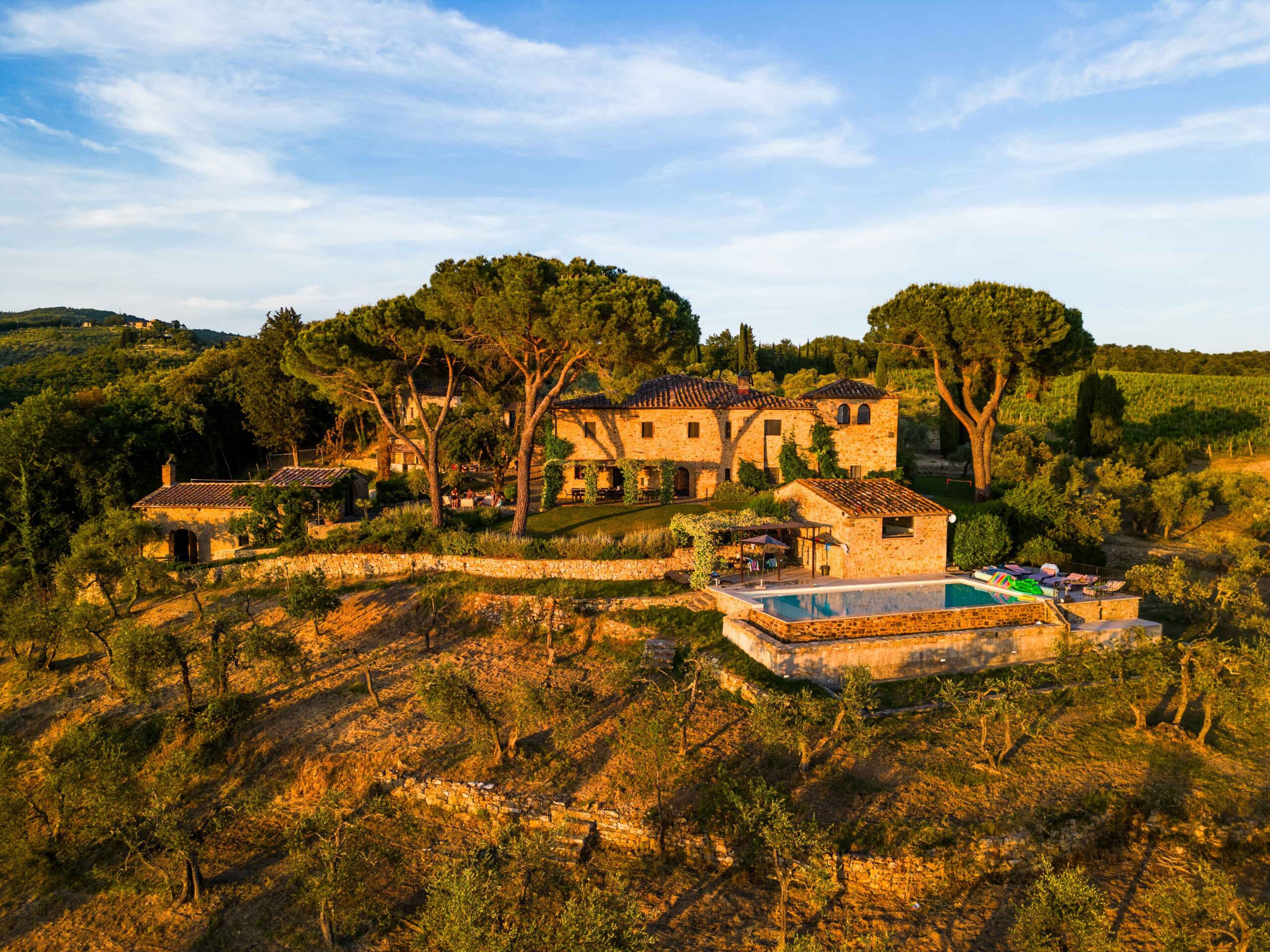
If the reason for coming is the wine, the decision is already made. Chianti Classico is the corridor between Florence and Siena where the Gallo Nero estates sit shoulder to shoulder, and in September it is the most alive landscape in Italy: tractors on the strade bianche, cellars open at odd hours, and the smell of fermentation drifting across the hills by the third week.
What a base here buys is proximity to the estates. The great cellars Castello di Ama, Fonterutoli, Badia a Coltibuono — are fifteen to forty minutes from most of our houses, which turns a tasting from a day trip into an afternoon. Florence is an hour, Siena forty minutes, and the towns in between Greve, Radda, Panzano, Castellina carry the region’s best butcher, its most serious enotecas and a September calendar of sagre that rewards the guests who abandon their plans.
The chianti villa rentals we place divide into two families. The first is the restored fattoria: stone, vaulted ceilings, olive groves, working agricultural land around the house — the version of Tuscany people picture before they arrive. The second is the contemporary conversion: the same stone shell rebuilt around glass, infinity pools and gourmet kitchens for guests who want the postcard outside and the twenty-first century inside. Both kinds of villas in chianti sit on working agricultural land, and in September that is the whole point.
Villa Chianti is the second family at its most convincing: five double suites for ten guests, a 16-by-5-metre saltwater infinity pool, a grove of 120 olive trees, a gourmet kitchen built around a travertine island, and daily housekeeping with 24/7 concierge. Florence is 39 kilometres away, which in September means dinner in the city and home before midnight without anybody dreading the drive.
Who chianti villa rentals suit: wine-led groups of six to twelve, couples travelling together, guests who want to eat and drink extremely well and drive very little. Who they do not: families needing a beach within reach, or groups whose non-drivers will feel stranded — the villas in chianti are rural by definition, and a car is not optional here.
The Lucca hills where lucca villa rentals reach everything
The hills behind Lucca are Tuscany’s most underrated base, and the one our concierges recommend most often to groups that cannot agree with themselves. The reason is geometry: from a house in these hills you are twenty minutes from a walled Renaissance city, forty from the Versilia coast, an hour from Florence, an hour and a half from Chianti’s cellars, and half an hour from Pisa’s airport. Nothing else in Tuscany reaches so much from one driveway.
Lucca itself is the argument for lucca villa rentals over every other base. It is the only major Tuscan city that never surrendered to tourism — a complete Renaissance wall you can cycle along on a Sunday morning, a piazza built inside a Roman amphitheatre, Puccini’s birthplace, a concert calendar that runs all autumn, and restaurants that still price for the people who live there. In September it is at its best: warm days, no crowds, and the Versilia beaches still swimmable forty minutes west.
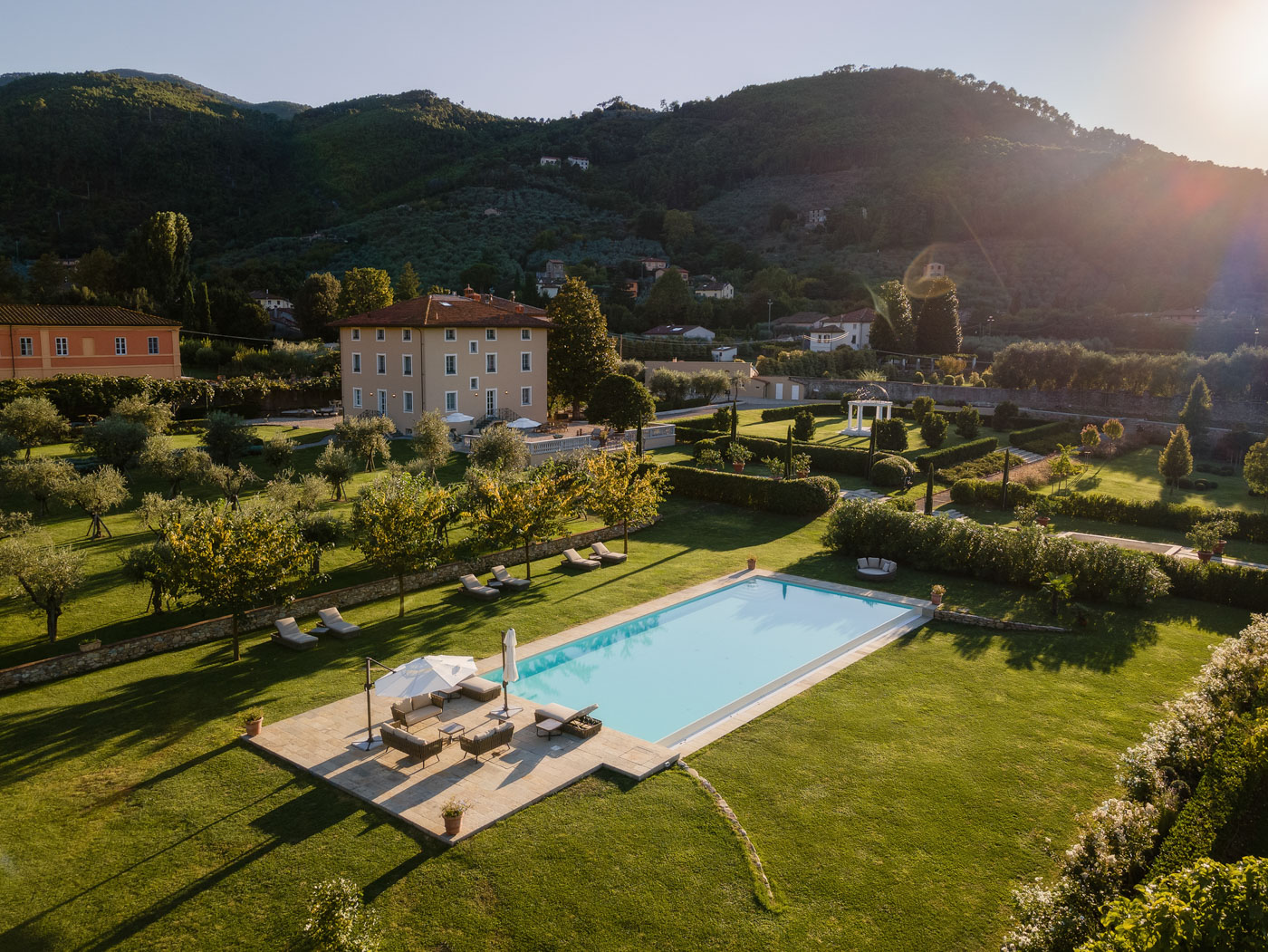
That reach is why lucca villa rentals behave differently from the rest of the region’s inventory. Where a Chianti house is bought for its landscape, lucca villa rentals are bought for their access — and the properties reflect it, running larger, greener and more oriented to groups that will split up during the day and reconvene at dinner. The historic estates in these hills were built as summer retreats for Lucchese silk merchants, which means eighteenth-century gardens, lemon houses, frescoed salons and the kind of scale that modern villas rarely attempt. It is the reason lucca villa rentals hold the largest headcounts in our Italian portfolio.
Villa Medea is the exemplar of the category: a fifteenth-century villa fully renovated, ten minutes from the walls of Lucca, with twelve bedrooms for twenty-four guests across the main house and the adjacent Red House, manicured Italian gardens, a pool and whirlpool, a pizza oven, daily breakfast service, 24/7 concierge and a private chef on option. It also rents in six-, eight- and fourteen-bedroom configurations — the flexibility that makes lucca villa rentals the practical answer for reunions, milestone birthdays and the multigenerational groups that cannot fit one number. Very few lucca villa rentals of this vintage have been renovated to this standard, which is why it books early even in the shoulder months.
Among lucca italy villa rentals, this is also the profile American clients ask us for most, and the reason lucca villa rentals convert so well for reunions: a single property that absorbs a group of twenty-four, sits half an hour from an international airport, and puts a real Italian city — not a hilltop village with three restaurants — within a ten-minute drive. September adds the last argument for lucca villa rentals specifically: the Versilia festival season runs into the month, and the coast is thirty minutes from the gate.
What a September week actually looks like from here
The case for lucca villa rentals is easiest to make as an itinerary rather than an argument. Monday: the walls, by bicycle, before the heat four kilometres of Renaissance rampart planted with plane trees, and coffee in the Piazza dell’Anfiteatro afterwards. Tuesday: Versilia, forty minutes west, where the beach clubs of Forte dei Marmi are still fully staffed in September and the sea is at its warmest of the year. Wednesday: Florence by train from Lucca station, ninety minutes door to Uffizi, no parking and no driver. Thursday: the group splits half to Pisa and the coast, half to a Chianti cellar ninety minutes east — and everybody is home for dinner.
Friday is the one that sells the base. It is spent at the house: the pool, the gardens, the pizza oven lit at seven, and the discovery that the reason to rent a large Tuscan estate was never the sightseeing. The best lucca villa rentals are built for exactly this day, with grounds that hold twenty-four people without anybody feeling crowded and a kitchen that a chef can actually work in. Guests who book lucca villa rentals for a week end up spending three of those days on the property, and the good ones are designed on that assumption.
The practical arguments
Three things separate lucca villa rentals from the rest of the Tuscan board, and all three matter more to large groups than to couples.
Airport proximity is the first. Pisa is thirty minutes from most lucca villa rentals, Florence about an hour, and both take direct European connections which for an American group arriving via London or Paris means the transfer is a detail rather than a half-day. Among lucca italy villa rentals, several of the historic estates will arrange the transfers as part of the booking.
Configuration flexibility is the second, and it is close to unique to lucca villa rentals. Because these were built as multi-building estates — main villa, farmhouse, lemon house, staff cottage — many lucca villa rentals let you take six bedrooms or sixteen from the same property. Groups whose final headcount moves between the deposit and the arrival find this worth more than any single amenity.
And the city is the third. It is genuinely rare in Tuscany to have a walled city with concerts, restaurants and a Sunday market ten minutes from a rural estate. Guests who have tried a hilltop-village base and spent the week driving to dinner understand immediately why lucca villa rentals keep their clients for a second and a third visit.
Who the Lucca hills suit: large and multigenerational groups, reunions, mixed parties of drivers and non-drivers, anyone combining sea and city. Who they do not: purists who want vineyards outside every window — for that, the villas in chianti are the answer.
Val d’Orcia the address for the light
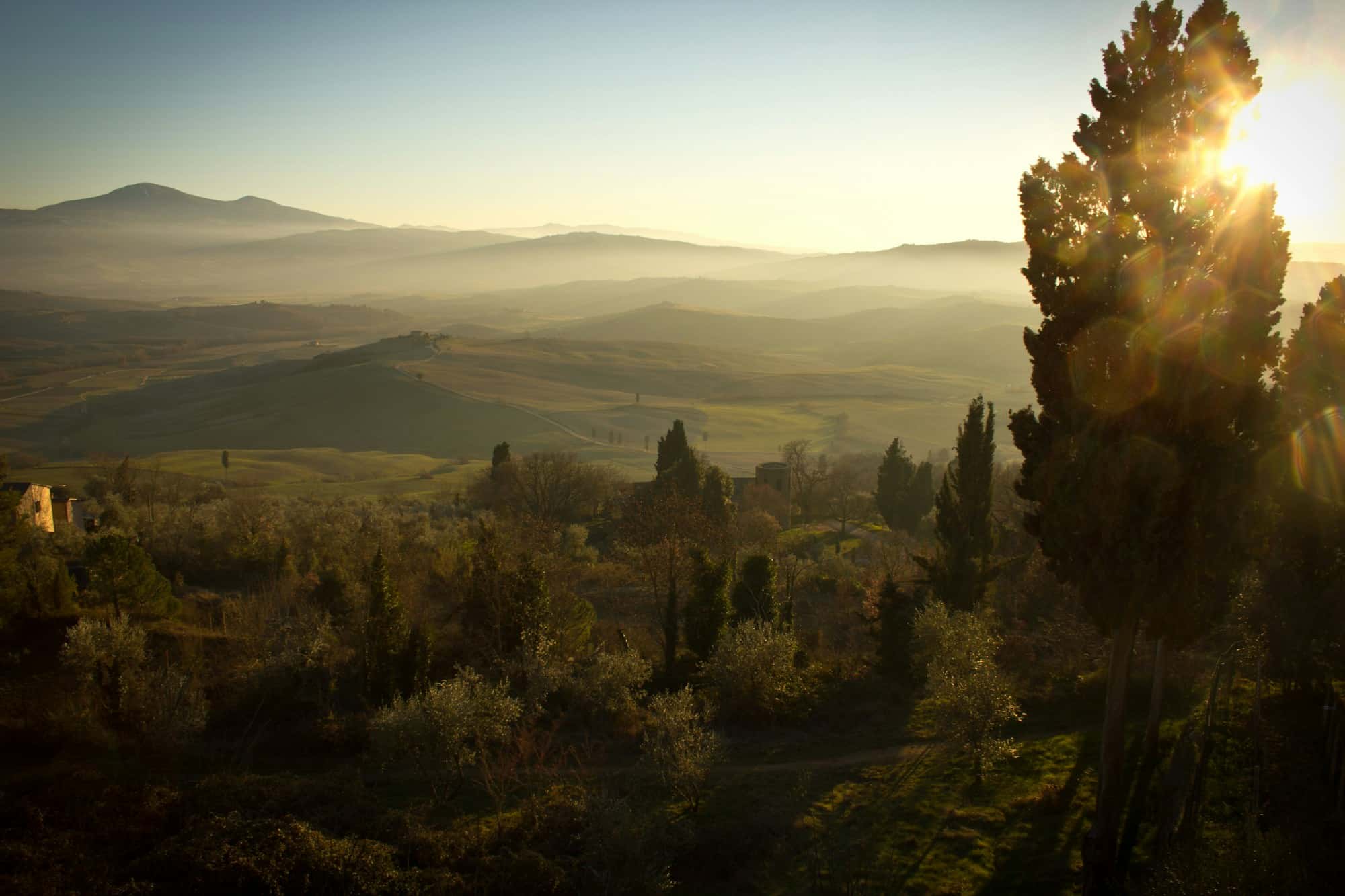
And then there is the Val d’Orcia, which is not really a base at all but a landscape people organise a holiday around. This is the Tuscany of the calendars: the cypress avenues, the isolated chapel at Vitaleta, the clay hills that turn from green to gold to brown across the season, the whole valley protected as a UNESCO World Heritage Site precisely because it looks the way it does.
September is when it looks that way most. The harvest light arrives in the second week — long, low, slightly amber — and photographers who have been coming for twenty years still time their visits to it. Pienza and Montalcino are twenty minutes apart; Brunello is at its most serious in the cellars above the town; the thermal springs at Bagno Vignoni are warm and, in the third week, almost empty.
What the valley does not have is convenience. It is two hours from Florence, an hour and a half from Siena’s nearest good hospital, well over two hours from an airport, and its restaurants close earlier than anywhere else in this piece. Groups who choose it choose it deliberately — for the silence, the drives, the photography, and the particular pleasure of a landscape that asks nothing of you. It is the base for second and third visits to Tuscany, rarely the first.
Who the Val d’Orcia suits: couples, photographers, small groups on a return visit, anyone whose ideal day contains one drive and no schedule.
Which base for which group
| Group profile | Base | Why in September |
|---|---|---|
| Wine-led group of 6–12 | Chianti Classico | Vendemmia access; cellars minutes away |
| Reunion or multigenerational, 14–24 | Lucca hills | Scale, flexible configurations, airport at 30 min |
| Mixed group: some want sea, some want cities | Lucca hills | Versilia at 40 min, Florence at 60 |
| Couples, second visit | Val d’Orcia | The harvest light, and nothing else asked of you |
| First trip to Tuscany, want the postcard | Chianti Classico | The landscape everyone came for |
| Group with non-drivers | Lucca hills | A real city within ten minutes |
| Photographers | Val d’Orcia | Second week onward, without argument |
Booking a Tuscan September
Three practical notes that apply whichever base you choose.
The vendemmia is a moving target. It begins in the second week of September in most of Chianti and runs into early October at altitude — but it shifts by up to ten days with the year’s weather, and cellars confirm their schedules late. If harvest access matters to your group, tell the concierge at the shortlist stage; the estates that host private visits book their September slots weeks ahead and the good ones close first.
September prices are not August prices. The second half of the month, in particular, sits well below high season across the region while delivering warmer pools, better tables and emptier towns. Among lucca villa rentals and their Chianti equivalents, the last ten days of September are the single best value-to-quality position of the Tuscan year — and on the largest lucca villa rentals, where the weekly figure is divided across twenty-plus guests, the arithmetic becomes difficult to argue with.
And the staffing question deserves an early answer. Tuscan houses run lighter than Caribbean or Greek villas — housekeeping and concierge as standard, chef on option — so if your group wants dinners at home rather than out, the chef is booked with the villa, not after it. The larger lucca villa rentals frequently include daily breakfast service in the rate, which is not the same thing as a chef and is worth confirming in writing. In September, the good chefs are also working the harvest.
Frequently asked questions
Which Tuscan base is best for a first visit? Chianti Classico, for most groups: the landscape people came for, Florence and Siena both within an hour, and the September harvest happening around the house. Lucca wins if the group is large or divided in its interests.
Are lucca villa rentals a good choice for large groups? They are the region’s strongest answer for scale. The historic estates behind the city were built large, several lucca villa rentals offer flexible configurations from six bedrooms to fourteen or more, and Pisa airport is half an hour away — which matters more with twenty-four people than with eight.
Do lucca villa rentals come with a private chef? Usually on option rather than included. Housekeeping and concierge are standard across lucca villa rentals; breakfast service is common on the larger estates; a full chef is arranged with the booking and, in harvest season, should be requested at the same time as the house.
Is September warm enough to swim in Tuscany? Comfortably, especially in the first three weeks. Pools hold summer heat well into the month, and the Versilia sea — forty minutes from the Lucca hills — is at its warmest of the year in early September.
How far apart are the three bases? Chianti to Lucca is about ninety minutes; Chianti to the Val d’Orcia about the same; Lucca to the Val d’Orcia rather more. Comfortable as a day trip, tiring as a routine — which is why the base matters.
Do we need a car? In Chianti and the Val d’Orcia, yes, without exception. From lucca villa rentals a driver can substitute for most days, because the city is close and the coast is a single straightforward run.
When should we book for September? The best Tuscan houses commit by spring for the harvest weeks, but September releases more than August does, and late availability is genuine here. For the last ten days of the month, four to six weeks of notice is often enough though the largest lucca villa rentals, being few, are the exception that still rewards early signatures.
Choosing your base
Chianti for the wine, Lucca for the reach, Val d’Orcia for the light. Get the valley right and the rest of the holiday arranges itself around it the harvest visits, the dinners, the day the group splits in three directions and reconvenes on the terrace at eight.
Browse the full collection of Tuscany villa rentals every house in this piece, and the rest of the region’s September board.
Request a Tailored Selection — tell us your group, your dates and whether the wine, the reach or the light matters most, and a concierge will return a shortlist matched to the right valley, usually within one business day.