Most shortlists of places to visit in Tuscany name the same six towns and stop. This one is organised differently: by where you sleep. On a peninsula where the drives are longer than the map suggests, the base you choose decides which Tuscany you actually get — the medieval lanes, the golden valleys, the forests, or the coast almost nobody writes about.
For a first visit, the Florence hills if you want culture with easy day trips into the countryside, and Chianti if wine, villages and the classic Tuscan landscape are the priority. For a second visit, or for anyone who wants the version without coaches, go to the Garfagnana, the Casentino forests, the Tufa Triangle or the Etruscan Coast. Choose the base first; the itinerary follows from it. Browse the Tuscany villa rentals collection once you know which one you want.

Where to start, if it is your first Tuscany
These two answer most first visits, and between them they cover the postcard: Renaissance cities within reach, vineyards at the end of the drive, hill towns for the afternoons.
The hills immediately above Florence are the compromise that is not a compromise: olive terraces and cypress avenues, with the Uffizi, the Duomo and the Oltrarno twenty minutes away. You can spend a morning in the Renaissance and be back at the pool by two, which is exactly what most families want and rarely get.
It is also the easiest base for arrivals. Florence Airport is close, Pisa is straightforward, and the drive from the motorway is short — which matters more than it sounds on the first afternoon with a jet-lagged group.
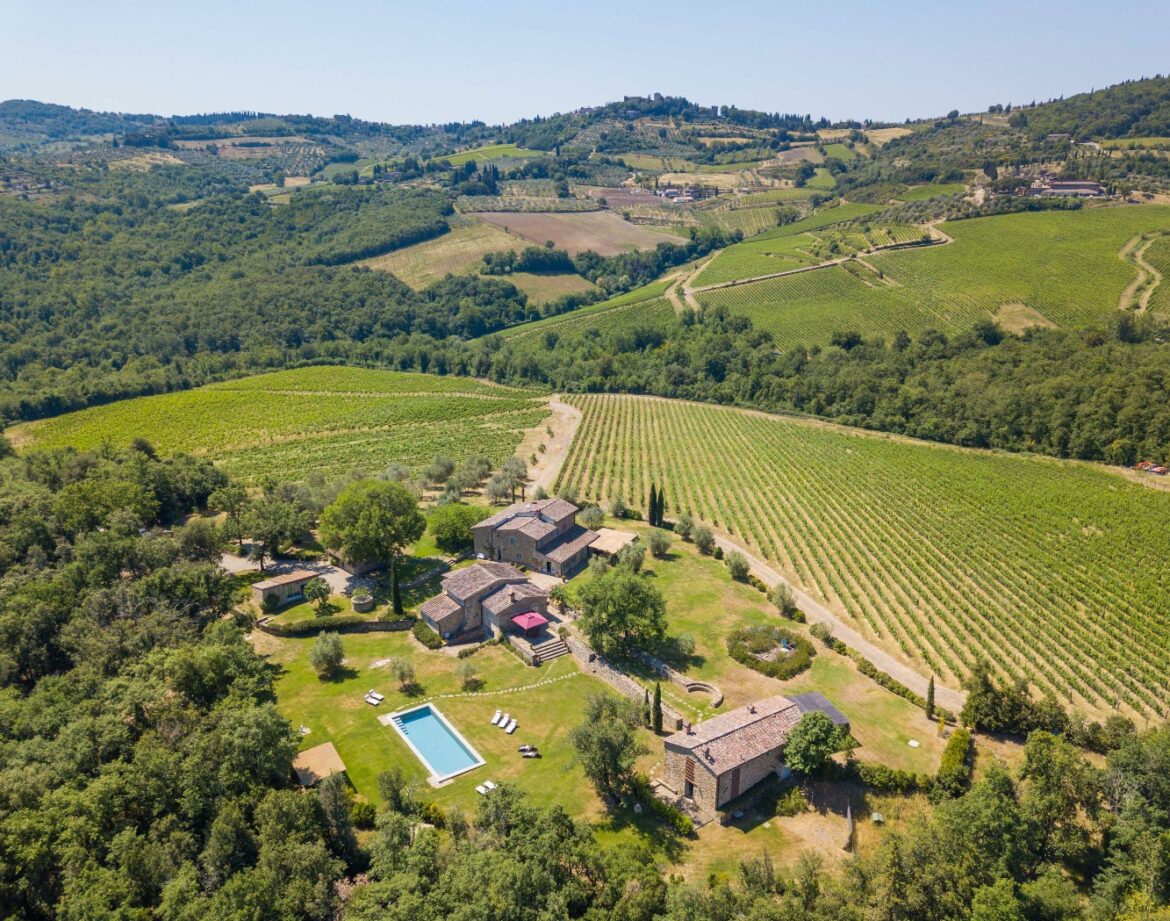
The landscape people mean when they say Tuscany: vines in ordered rows, stone villages on ridgelines, and wine estates that will open a cellar for you if someone calls ahead. Greve, Panzano, Radda and Castellina are close enough together that a day can be built from two of them without a long drive.
The practical argument for Chianti is dinner. Several villages are walkable from well-placed villas, which means one evening a week nobody has to drive — a genuine luxury in a region where tasting menus and tasting rooms tend to compete.
Lucca is the northern base, and the one that consistently surprises people. Intact Renaissance walls you can cycle around, a dense centre that is genuinely lived in rather than performed, and Puccini’s birthplace at the middle of it. It is quieter than Florence and Siena in every month of the year.
It is also the gateway to the wilder north — the Garfagnana and the Lunigiana are close, which makes Lucca the practical half of a two-base trip that ends in the hills.
Where to go when you have already done the postcard
This is the part of the shortlist most guides leave out, and the reason to read a villa specialist rather than a top-ten list. Four areas, each a genuine landscape rather than a detour.
A river valley running north from Lucca between the Apuan Alps and the Apennines — marble quarries on one side, chestnut woods on the other, and villages that have never been on a tour route. The food changes here too: farro, chestnut flour, mountain pecorino instead of the coastal-Tuscan register.
Tuscany’s forgotten corner, where the region runs into Liguria and Emilia. Castle after castle along the old pilgrim road, prehistoric stone stelae in the museums, and a landscape of steep green valleys that feels more Alpine than Tuscan. The sea at the Cinque Terre is close enough for a day.
The forest sanctuaries: a national park of beech and silver fir in the upper Arno valley, with the monastery at Camaldoli and the sanctuary at La Verna set into the hillside. It is the quietest landscape in Tuscany and the coolest in August, and it is twenty minutes from Arezzo when you want a town again.
Three towns in the far south, built on and into volcanic tufa so that the buildings and the cliffs are the same material and the same colour. Pitigliano rises straight out of the rock; between the towns run the vie cave, sunken Etruscan roads cut deep into the stone and walled with moss. There is nothing else like it in Italy.
The same region, a different holiday
The classic bases are busy because they are excellent, not because they are overrated. But the calculation changes in July and August, when the hill-town circuit fills and the drives lengthen. The four areas above stay quiet through the whole season, and three of them are cooler than the Chianti valley floor by several degrees in the middle of the day.
The wild coasts
The stretch of shoreline south of Livorno, backed by umbrella pines and the wine country of Bolgheri — the cypress avenue, the Super Tuscan estates, and beaches that are pine forest to the waterline rather than concrete. Quieter stretches exist even in August if you know which ones.
The Maremma is the wilder south: butteri cattle country, a coastal park, thermal springs at Saturnia, and the promontory of Monte Argentario with Porto Ercole and Porto Santo Stefano on either side of it. It is closer to Rome than to Florence, which makes it the natural southern half of a two-base trip — or a whole holiday on its own for anyone who wants sea and countryside without choosing.
Which base for which trip
| If you want | Base yourself | Why |
|---|---|---|
| Culture and a first visit | Florence hills | City in the morning, pool by two |
| Wine and villages | Chianti | Estates and walkable dinners in the same week |
| Quiet, and a northern base | Lucca | Intact walls, no crowds, gateway to the hills |
| Cool air in August | Casentino or Garfagnana | Forest and mountain, several degrees cooler |
| Landscape nobody else photographs | Tufa Triangle | Pitigliano, Sovana, Sorano and the vie cave |
| Wine and swimming | Etruscan Coast | Bolgheri behind, pine-backed beaches in front |
| Sea, countryside and a Rome arrival | Maremma / Argentario | Closer to Fiumicino than to Florence |
| Castles, and a Liguria add-on | Lunigiana | The pilgrim road, the Cinque Terre within a day |
How long, and how many bases
The single most common planning error in Tuscany is treating it as one place. It is roughly the size of Wales, the roads are slow by design, and a “forty-minute” drive on the map is an hour with a village in the middle of it.
In the countryside a car is usually worth having for flexibility. But historic centres are ringed by ZTL restricted-traffic zones with camera enforcement, and fines arrive months later through the rental company. For tasting days, multi-stop itineraries or anything involving a historic centre, a private driver removes the problem entirely — and it is the single arrangement guests thank us for most often. We book them through our bespoke concierge service.
When to come
Late April to May and September to October are the region at its best: warm days, cool evenings, open terraces and far fewer people. High summer is glorious and busy in equal measure, and it is when the quieter areas above earn their place. For the fuller picture, see when summer really begins in Italy, and if you are still weighing Tuscany against elsewhere, Tuscany vs the Amalfi Coast vs Lake Como is the comparison to read first.
One planning note worth knowing: Tuscany sits at #1 in our Billionaire Villa Index, and Summer 2027 requests are already running at two to three weeks rather than one — which removes the best-placed houses from the calendar for far longer than a single booking would suggest. For groups of eight and up, start with large villas for family and friends’ reunions.
Frequently asked: places to visit in Tuscany
What is the best base in Tuscany for first-time visitors?
For first-time visitors, Florence Hills is ideal if you want culture with easy day trips into the countryside. Chianti is the best choice if wine, villages, and classic Tuscan landscapes are your priority.
How many days do you need for Tuscany?
Five days is perfect to experience one region well without rushing. With 7–10 days, plan on two bases (for example, a northern base like Lucca plus a southern base like Maremma/Argentario) to keep drives shorter and the pace relaxed.
Do I need a car in Tuscany?
If you’re staying in the countryside, a car is usually helpful for flexibility. If your plans include wine tastings, multi-stop days, or driving into historic centers with ZTL restrictions, hiring a private driver can make the trip significantly easier.
What are the best places in Tuscany for hidden gems?
For quieter, lesser-known Tuscany, look to Garfagnana, Lunigiana, the Casentino forests, the Tufa Triangle (Pitigliano, Sovana, Sorano), and the quieter stretches of the Etruscan Coast.
Where should I start if I want the full villa-life version of Tuscany?
Start by choosing a well-located villa base, then layer in the details that make the week effortless—private drivers for tasting days, pre-booked winery appointments, and in-villa experiences like a private chef—so you can enjoy Tuscany without logistics.
Choosing your Tuscany
The shortlist is not really nine places, it is one decision made twice: north or south, classic or quiet. Settle that, put a well-placed villa under it, and the rest — the cellar appointments, the driver on tasting days, the chef on the evening nobody wants to move — is arrangement rather than effort.
North or south, classic or quiet — send us your dates and party and an Italy specialist will come back with villas in the right area, with staffing and inclusions set out in writing. At no cost, and with no obligation.
The areas shortlisted here are those named in this guide’s own planning answers: the Florence hills, Chianti, Lucca, the Maremma and Argentario, the Garfagnana, the Lunigiana, the Casentino forests, the Tufa Triangle of Pitigliano, Sovana and Sorano, and the Etruscan Coast. Itinerary lengths and driving guidance restate the same answers. Villa availability and rates move weekly and are confirmed in writing before a booking is committed.