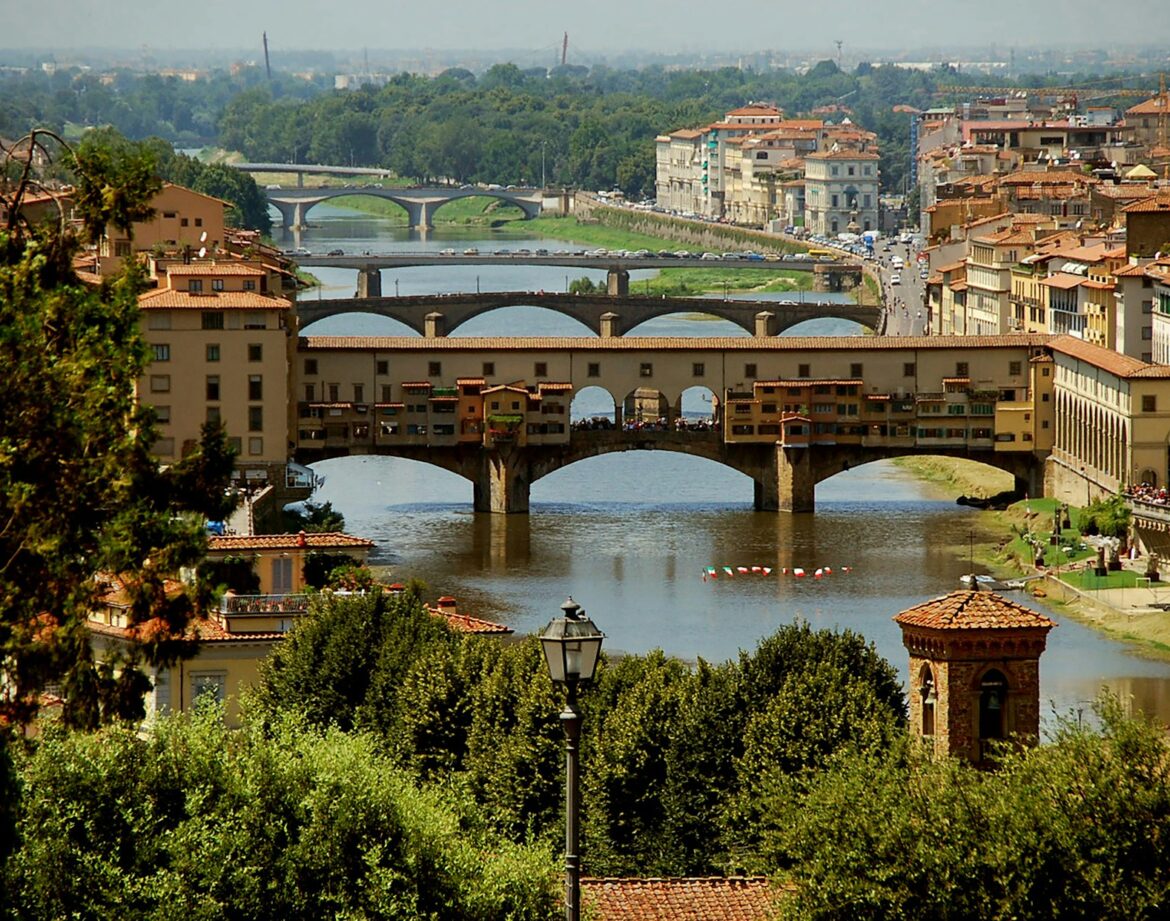
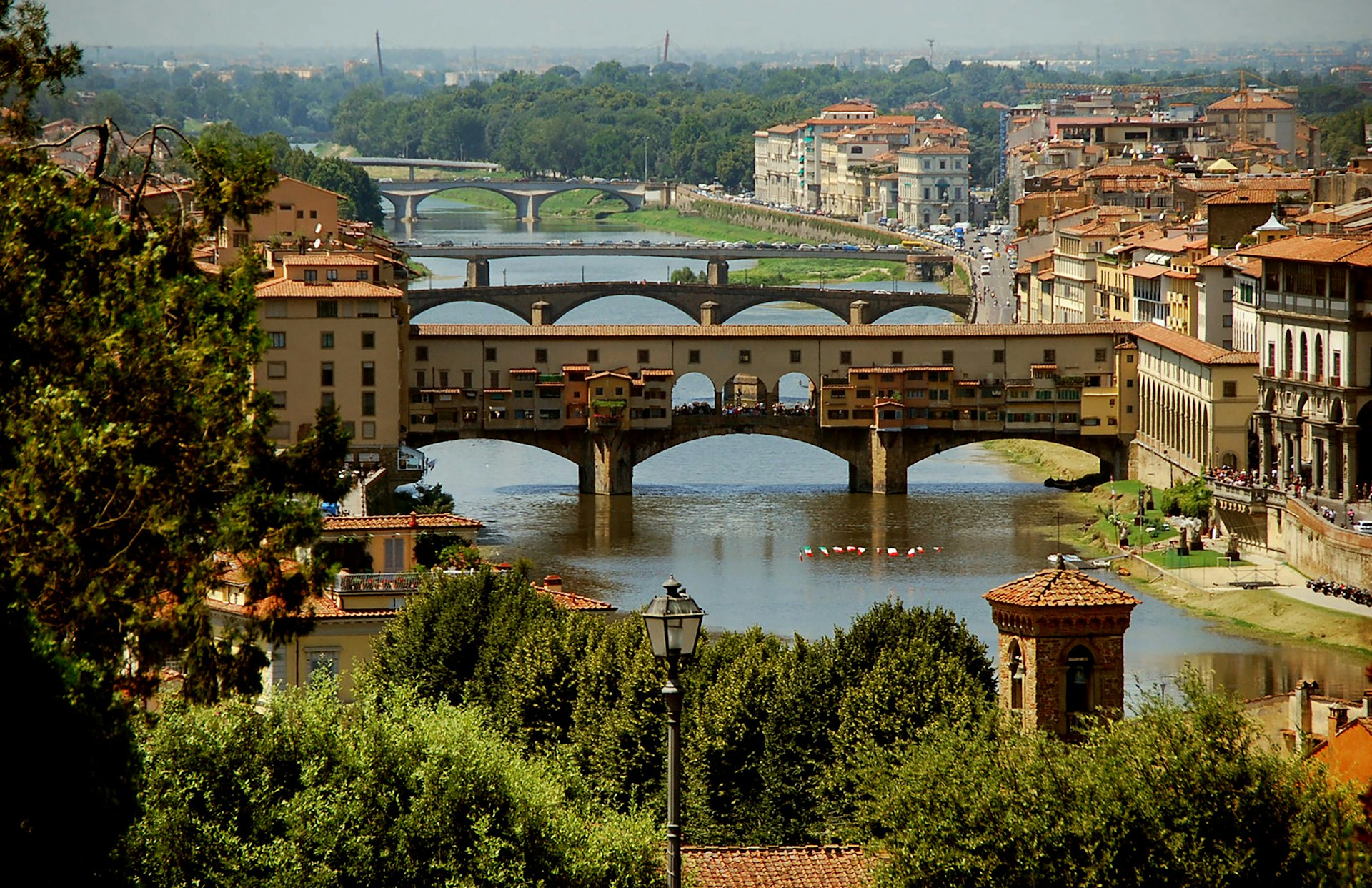
Florence is small. That is the whole problem, and the whole answer. A Renaissance city built for sixty thousand people now receives millions a year, and almost all of them walk the same half-mile between the Duomo, the Uffizi and the Ponte Vecchio. Choosing when you go does not change what you see — it changes whether you can see it at all.
The best time to visit Florence is late April to May and mid-September to October : warm enough to eat outside, cool enough to walk all day, and materially quieter than high summer. November and January–February are the value windows — cold and sometimes wet, but the museums are yours. July and August are hot, crowded and the one period we steer guests away from unless the dates are fixed. Whichever window you take, the city is best treated as a day trip from the hills: browse the Tuscany villa rentalscollection and you can be at the Uffizi by nine and back at a pool by two.
The four Florences
The city at its most flattering. Wisteria over the walls in April, the Boboli and Bardini gardens at their peak, and daytime temperatures that make walking from Santa Croce to the Oltrarno a pleasure rather than an ordeal. Evenings are still cool enough for a jacket, which is the tell of a good travel month.
The caveat is Easter, which moves each year and brings a sharp spike in visitors along with it. Late April into May , once Easter has passed, is the single best fortnight in the Florentine calendar — and it is priced accordingly, so book early rather than late.
Florence sits in a river basin ringed by hills, which is beautiful on a postcard and unforgiving in July. The stone holds the heat, the streets are narrow, and the queues are outdoors. Add the peak of international arrivals and you have the most demanding version of the city.
August has its own character. Many Florentines leave for the coast around Ferragosto on 15 August , and a proportion of the best neighbourhood restaurants close for two or three weeks. The centre stays busy with visitors; the city behind it half-empties. It is an odd, hollowed-out atmosphere that some people love.
The connoisseur’s answer. From the middle of September the heat breaks, the summer crowd thins, and the light turns the colour that painters came here for. October is reliably lovely and still warm enough to eat outside. The vineyards in the hills are harvesting, which makes a Florence-plus-Chianti week particularly good value of experience.
November is the underrated month: genuinely quiet, often crisp and clear, with the new olive oil arriving in the markets. It rains more, and some days are grey — but a wet morning in Florence means an empty Uffizi, which is a fair trade.
Cold, sometimes damp, occasionally brilliant — and almost empty. January and February are the only months when you can stand in front of the major works without negotiating for the space, and that is a different experience of the same city. Bring a proper coat; the damp cold in the river basin is sharper than the temperature suggests.
December is the exception within the exception: the run-up to Christmas brings markets, lights and a second wave of visitors, and rates rise with them. The quiet returns in the second week of January.
Month by month
A working summary. Temperatures are typical daytime highs rather than records, and crowd levels describe the historic centre — a villa in the hills is quiet in every month of the year.
| Month | Typical high | Crowds | What it is like |
|---|---|---|---|
| January | 10°C / 50°F | Lowest | Cold and damp, museums genuinely quiet. The best month for the art alone. |
| February | 12°C / 54°F | Low | Similar, with more bright days. Rates at their softest. |
| March | 16°C / 61°F | Building | Unpredictable — brilliant one day, wet the next. Gardens waking up. |
| April | 19°C / 66°F | Busy | Beautiful, and busy around Easter. Wisteria and the gardens at their best. |
| May | 24°C / 75°F | Busy | Arguably the finest month: warm days, cool evenings, everything open. |
| June | 28°C / 82°F | Peak | Hot and full, with the city’s biggest traditional events late in the month. |
| July | 32°C / 90°F | Peak | The hardest combination of heat and crowds. Start early or not at all. |
| August | 32°C / 90°F | Peak | Hot; locals away around Ferragosto and some restaurants closed. |
| September | 27°C / 81°F | Easing | Heat breaks mid-month. From then on, one of the two best windows. |
| October | 21°C / 70°F | Moderate | Warm enough to eat outside, harvest in the hills, superb light. |
| November | 15°C / 59°F | Low | Wetter and quiet. New olive oil in the markets. Excellent value. |
| December | 11°C / 52°F | Festive spike | Markets and lights raise both crowds and rates until early January. |
Three dates that change the city
Most guides list festivals as attractions. It is more useful to know which ones fill the centre, because on those days the calculation about where you stay changes entirely.
- Scoppio del Carro, Easter Sunday. The Explosion of the Cart — a decorated wagon drawn to the Piazza del Duomo and set off by a mechanical dove launched from inside the cathedral. Spectacular, deeply Florentine, and the single most congested morning of the spring.
- Calcio Storico and the Festa di San Giovanni, June. The historic football played in costume in Piazza Santa Croce, culminating around 24 June , the feast of the city’s patron saint, which closes with fireworks over the Arno. Extraordinary to witness; the centre is impassable.
- Pitti Uomo, January and June. The menswear trade fair at the Fortezza da Basso. It has no tourist dimension at all, and it books out the best hotels and restaurants for its run. If your dates coincide and nobody warned you, that is why the city feels full in an otherwise quiet month.
Easter moves each year, Calcio Storico’s schedule is confirmed annually, and Pitti dates are published by the organiser. All three are worth checking against your window rather than discovering on arrival — we do it as a matter of course for every Florence stay we arrange.
Book the museums before you book the restaurant
Even in the quietest month, the Uffizi , the Accademia— where the David is — and the climb up Brunelleschi’s dome run on timed entry, and the dome in particular is reserved well ahead. The queue you see snaking around the Piazzale degli Uffizi is almost always the without-reservation queue.
The second constraint is the car. Florence’s historic centre is a ZTL — a restricted traffic zone with camera enforcement — and fines reach you months later through the rental company. Nobody staying outside the city should be driving into it.
Where to stay, and why it is not in the city
Almost every guest who asks us about Florence assumes they should stay in it. Most end up in the hills above, and the reason is the timing question this whole page is about: from a villa fifteen or twenty minutes out, you arrive at opening time, do the city while it is still civilised, and leave before the worst of the afternoon.
That is the argument in every season, and it is decisive in July and August. It also gives you the rest of Tuscany — Chianti, Siena, the Val d’Orcia — without rebasing halfway through the week. Our shortlist of places to visit in Tuscanysets out how the regions differ and which base suits which trip.
For groups, the case is stronger still: a fully staffed villameans the day ends with dinner already handled rather than a restaurant booked for eleven people at a fixed hour. For eight and above, start with large villas for family and friends’ reunions ; for the full regional picture, the Italian villas for rentcollection covers everything beyond Tuscany.
Tuscany sits at #1 in our Billionaire Villa Index , and Summer 2027 requests are already running at two to three weeks rather than one. That matters for a Florence trip because it removes the best-placed hill villas from the calendar for far longer than a single booking would suggest — the spring and autumn windows recommended above are exactly the ones that go first.
Building the week around the weather
The practical version of all this is simple. In spring and autumn , put the city days in the middle of the week and keep the ends for the hills. In summer , invert it: city at eight in the morning, back for lunch, nothing after two. In winter , do the opposite again — the museums are the point, so build whole days around them and let the countryside be the evening.
Transfers, cellar appointments, restaurant tables and the driver who solves the ZTL are all arranged through our bespoke concierge service , which is generally what turns a well-timed trip into an effortless one. If you are still deciding between regions rather than months, read Tuscany vs the Amalfi Coast vs Lake Comofirst, and when summer really begins in Italyfor the wider seasonal picture.
Frequently asked: the best time to visit Florence
What is the best month to visit Florence?
May and October are the two strongest single months. May gives warm days and cool evenings with everything open; October offers the same walkability with fewer people, softer light and the harvest under way in the surrounding hills. If you can only travel in one, take late September to early October.
What is the cheapest time to visit Florence?
January and February, once the festive period has passed. Rates are at their lowest, the museums are genuinely quiet, and you can stand in front of the major works without queueing. The trade-off is cold, damp weather and reduced hours at some smaller sites. November is the next best value, with better atmosphere and more rain.
Is August a bad time to visit Florence?
It is the hardest month, though not impossible. Daytime highs reach the low thirties Celsius, the historic centre is at its most crowded, and many Florentines leave around Ferragosto on 15 August, so a proportion of the best neighbourhood restaurants close. If your dates are fixed, base yourself outside the city, visit at opening time and treat the afternoon as pool time.
How many days do you need in Florence?
Two full days covers the essentials without rushing: one for the Uffizi and the cathedral complex, one for the Accademia, the Oltrarno and a garden. Three lets you slow down. Beyond that, most guests are better served using Florence as one element of a Tuscan week rather than a base in itself.
Do I need to book Florence museums in advance?
Yes, and in every season. The Uffizi, the Accademia and the climb up the cathedral dome all operate timed entry, and the dome is reserved furthest ahead. Even in quiet months the without-reservation queue is long. Book these before you book restaurants.
Can I drive into Florence?
Not into the historic centre. It is a ZTL restricted traffic zone with camera enforcement, and fines arrive months later through your rental company. If you are staying in the hills, use a driver who drops at the edge of the zone, or park outside and walk in.
Is it better to stay in Florence or outside the city?
For most of our guests, outside. A villa fifteen to twenty minutes into the hills lets you arrive at opening time, see the city before it fills, and be back at a pool by early afternoon — which is the difference between a good July trip and a difficult one. It also puts Chianti, Siena and the Val d’Orcia within reach without changing base mid-week.
Timing it well
Florence rewards planning more than almost any city in Italy, and the plan is not complicated: come in late spring or early autumn if you can, book the three big sights before anything else, stay in the hills, and let someone else deal with the car. Do that and the city stops being a queue and becomes what it was supposed to be.
Send us your dates and party size and an Italy specialist will come back with villas in the right part of the hills, with the museum bookings and the driver planned around them. At no cost, and with no obligation.
Temperatures are typical daytime highs, rounded, and vary year to year. Crowd levels describe the historic centre. Easter and the Calcio Storico schedule move annually and Pitti Uomo dates are published by the organiser — confirm all three against your dates before booking. Museum reservation requirements and opening hours are set by each institution and should be checked at the time of booking. Villa availability and rates move weekly and are confirmed in writing before a booking is committed.