
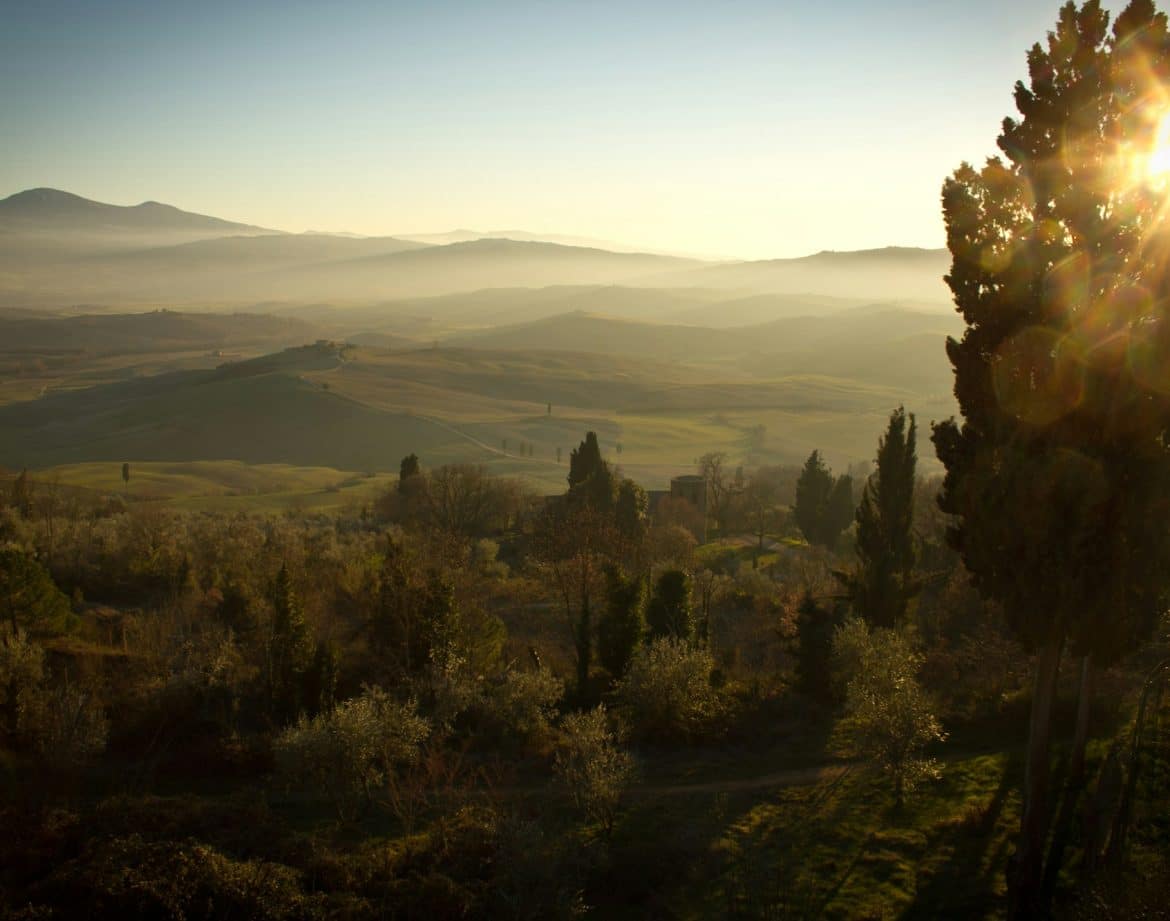
Tuscany has more beautiful towns than any holiday can hold, which makes the useful question not which are the prettiest but which are worth building a week around . Those are different lists. Some of the most photographed towns are best given two hours; a few of the less obvious ones reward three days and a walk at dusk. Below is the second list, ordered the way a specialist would use it — and paired with where to put the villa, because the drive between town and terrace is what decides how often you actually go. Start with the Tuscany villa rentalscollection once you know which corner you want.
For Renaissance perfection , Pienza. For wine , Montepulciano and Montalcino. For towers and drama , San Gimignano and Volterra. For a walkable Chianti base , Greve or Panzano. For a city that still works as a town , Lucca. And for the one most visitors miss — Cortona , high above the Valdichiana with Lake Trasimeno on the horizon and the best evening walk in Tuscany above it.
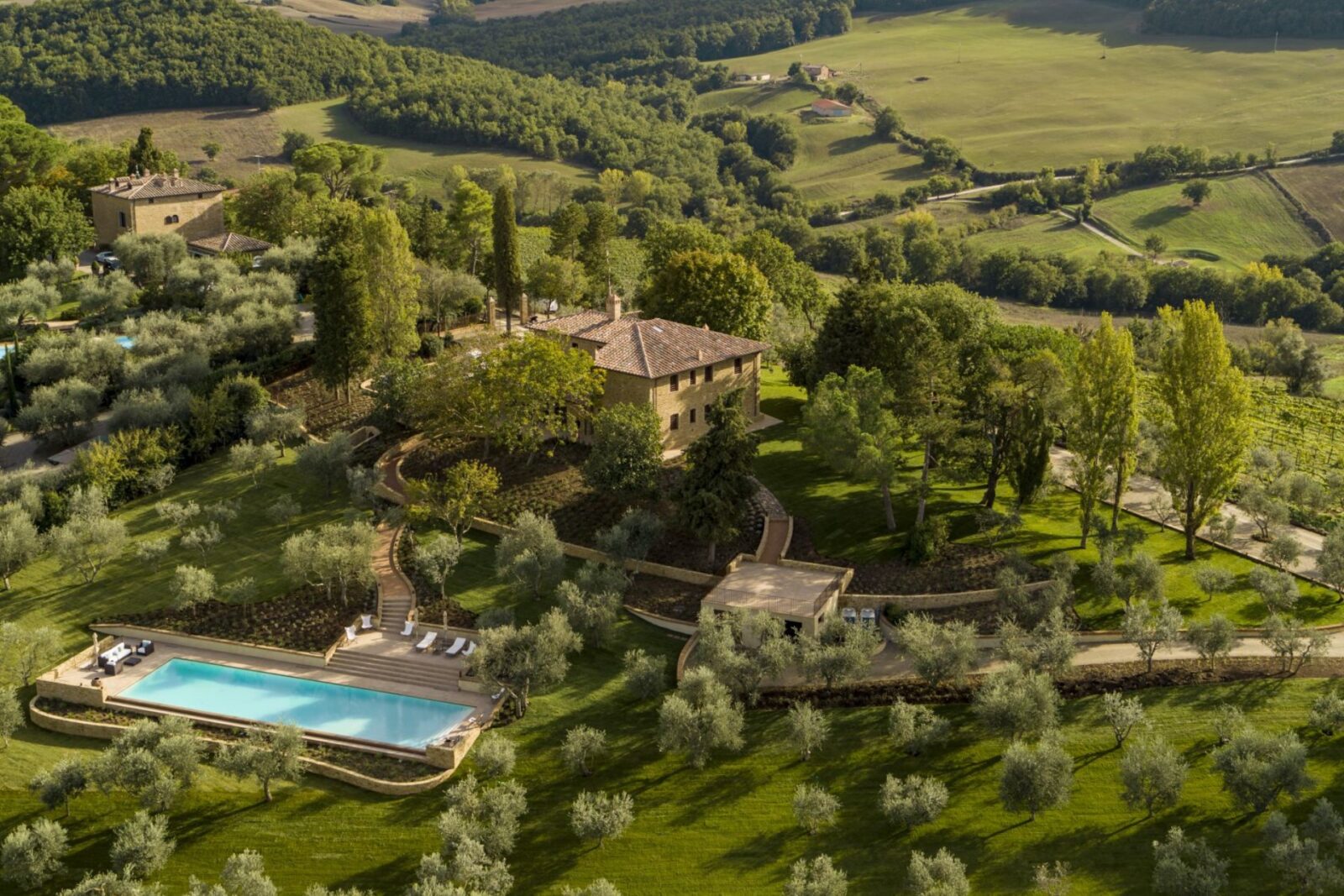
Cortona, and the walk up to the Fortezza
The town that surprised us most this year was Cortona , at the end of August — a few days rather than an afternoon, which turned out to be the whole point. It sits high on the western slope above the Valdichiana, so the light arrives late and leaves slowly, and on a clear evening you can see all the way across to Lake Trasimeno lying flat and silver in the distance. Umbria, from a Tuscan terrace.
The thing to do is the climb. From the piazza the streets narrow and steepen through the upper town until they give out into a path, and at the top is the Fortezza Medicea — the Girifalco fortress on the summit above the walls. It is a proper walk, steep enough to earn the view, and what you get at the top is the entire valley on one side and the lake on the other. Go in the last hour before sunset. Wear real shoes, not the ones you meant to wear to dinner.
Cortona also answers the question of what a town is for on a villa holiday. You cannot do this in two hours between other places. It needs an evening, and preferably three, which is exactly the argument for basing yourself close to one good town rather than driving to a different one every day.
The most beautiful towns in Tuscany, and what each is for
Ordered by what they give you rather than by fame. The Give it line is the honest part — some of these deserve a week and some deserve a long lunch, and knowing which is which is the difference between a full holiday and a tiring one.
Cortona
Valdichiana · Give it 2–3 daysEtruscan walls, steep streets, and a position that does all the work: high enough for the valley to open out below and for Lake Trasimeno to appear on the horizon at dusk. Quieter in the evening than the Val d’Orcia towns, because most visitors leave after lunch. The climb to the Fortezza Medicea is the single best walk on this list.
Pienza
Val d’Orcia · Give it a half dayA Renaissance town built to a single plan, small enough to cross in fifteen minutes and composed enough that every street ends in a view. The pecorino is not a tourist story — it is genuinely the reason people drive here. Best early morning or after five, when the coach traffic has gone.
Montepulciano
Val di Chiana · Give it a full dayA long ridge town that climbs and keeps climbing, with cellars cut into the rock beneath the main street and Vino Nobile at the end of most of them. More robust than Pienza and better for an actual dinner. The walk up is real; the reward is the piazza at the top.
Montalcino
Val d’Orcia · Give it a full dayBrunello’s town, on a hill with a fortress you can drink inside. Smaller and steeper than Montepulciano, and the views south over the Orcia valley are the ones people mean when they say Tuscany. Estate visits are the point here; the town is the frame.
San Quirico d’Orcia
Val d’Orcia · Give it a half dayThe quiet one, and the better base of the Val d’Orcia towns for anyone who wants to sleep near the landscape rather than in a destination. Horti Leonini, a Romanesque collegiata, and the cypress avenues everyone photographs a few minutes away.
San Gimignano
Val d’Elsa · Give it a morningThe towers are extraordinary and the crowds are relentless, which makes this the clearest case on the list for timing over duration. Arrive before nine or after six and it is medieval and strange and worth every step. Between those hours it is a queue.
Volterra
Val di Cecina · Give it a dayOlder and stranger than its neighbours — Etruscan, then Roman, then medieval, with alabaster workshops still cutting stone. Higher, windier and considerably less visited than San Gimignano an hour away, which is its whole appeal.
Greve in Chianti
Chianti · Give it a dayThe working heart of Chianti, with a triangular piazza, a proper market and butchers and wine shops that serve the valley rather than the visitor. Not the prettiest town on this list, and by some distance the most useful.
Panzano in Chianti
Chianti · Give it an eveningA hilltop village between Greve and Castellina, small and food-led, with views over the Conca d’Oro vineyards. The kind of place where dinner takes four hours and nobody drives, which is the highest praise a villa week can offer.
Lucca
North-west · Give it 2 daysA walled city that behaves like a town: intact Renaissance ramparts you can cycle the whole way round, an oval piazza built inside a Roman amphitheatre, and enough life in it to feel lived in rather than preserved. The easiest place on this list for a family.
Siena
Central · Give it 2 daysNot a small town, but it belongs here: the Campo is the finest public space in Italy and the contrade rivalry is genuinely alive rather than performed for visitors. Stay outside the walls and come in for evenings.
Where to put the villa
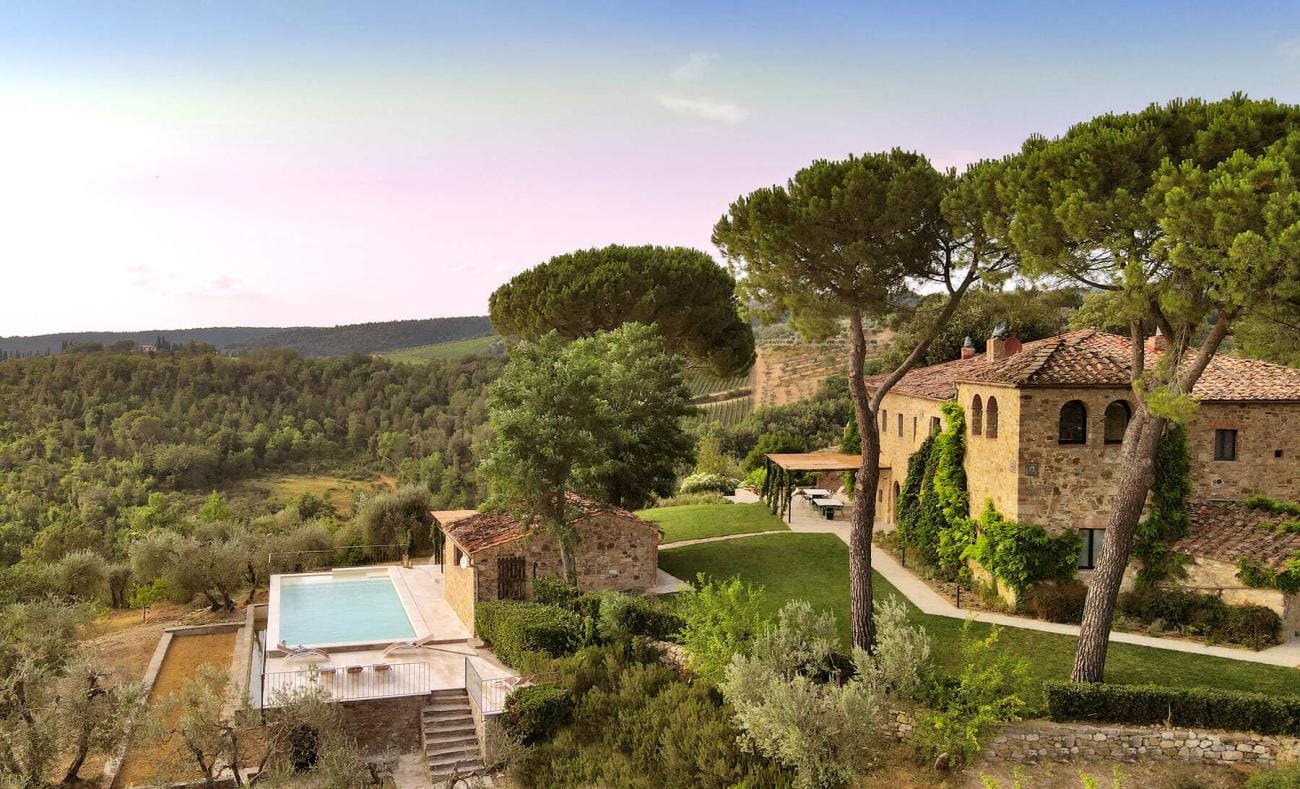
Almost every disappointing Tuscan week has the same cause: a beautiful house too far from the towns the group actually wanted. Distances look small on a map and drive long on ridge roads, so plan the base around the two or three towns you care most about and accept that the rest are day trips or nothing.
The Siena hills and the Val d’Orcia orbit
This is the strongest area for larger estates, because the properties are simply bigger here. Podere Tesoro , near Castello di Casole, sleeps twenty-two across a main casale, an independent guest cottage and a separate events barn — from $4,900 a night , thirty minutes from both Siena and San Gimignano, with Pienza, Montalcino and Montepulciano within reach for a day. It is the house to take when the group is large enough that the villa becomes the venue.
From a base on this side, Cortona is a longer run east — worth a night away rather than a day return, which is another argument for treating it as a destination in itself. Bagno Vignoni and Castiglione d’Orcia sit closer, and both reward an unplanned afternoon.
Chianti, for walkable evenings
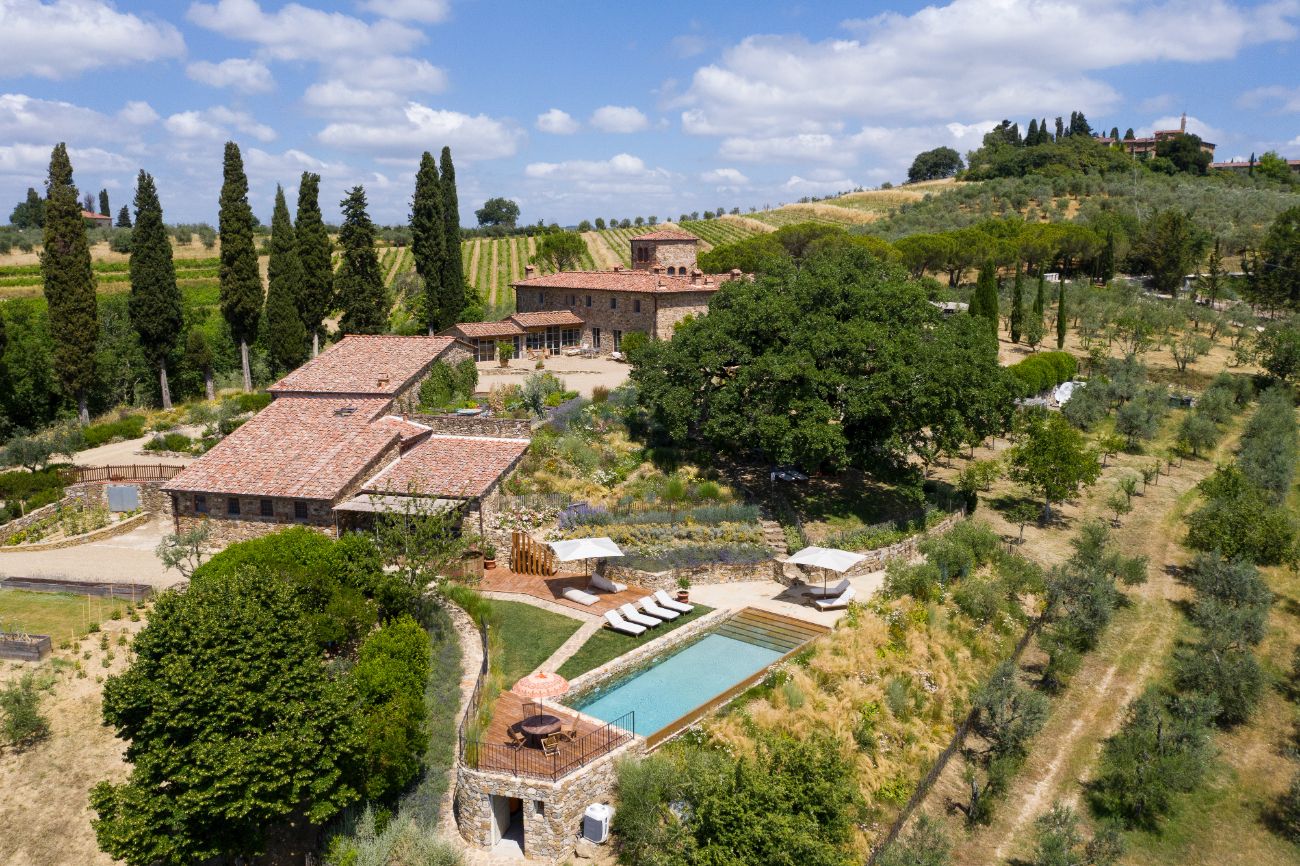
Villa Le Masse sits just outside Panzano — a thirteenth-century house for twelve, from $5,500 a night , with the village a fifteen-minute walk away. That walk is the rarest thing in a Tuscan week: one evening where nobody drives.
The Maremma, for the coast and Rome
Villa Veltuna is in the Maremma rather than the Val d’Orcia — seventy-five acres, sleeps fourteen, from $4,400 a night , twenty minutes from the Tyrrhenian and under two hours from Rome. The wrong base for the hill towns, the right one if the group is arriving on different flights or wants sea days in the mix.
Two houses of similar size can produce very different weeks. Veltuna includes a cook for eight hours a day plus a daily waiter; Le Masse includes a chef for one meal a day; Podere Tesoro includes breakfast and two hours of housekeeping with the chef on request. None is better — but only one suits your group. Our guide to what a fully staffed villa in Tuscany really includessets out the whole spectrum, and for parties over twelve start with large villas in Tuscany .
When to go, town by town
The towns change more by season than the countryside does. Crowd pressure, not weather, is usually what decides whether a visit is a pleasure.
| Season | Best for | Which towns | Watch out for |
|---|---|---|---|
| Late April – May | Gardens, walking, empty streets | San Gimignano, Volterra, Pienza — all at their easiest | Cellar and estate visits still need booking |
| June | Long evenings, the best balance of the year | Everything on this list | Peak villa demand begins |
| July – August | Late light, festivals, warm nights | Cortona and Lucca hold up best; hill towns are hot at midday | Midday heat — move sightseeing to early or late |
| September | Harvest, wine, still-warm evenings | Montalcino, Montepulciano, Greve, Panzano | Harvest weeks are busy at the estates |
| October | Light, food, quiet piazzas | Volterra, Lucca, Siena | Shorter days — two towns a day becomes one |
Seasonal guidance reflects our own guest patterns rather than published data. Check opening times, market days and festival dates close to travel; the towns run on their own calendars.
Why Tuscany prices the way it does
Tuscany sits first in our Billionaire Villa Index 2026 , and yet the average staffed week — around €21,000 — is half Lake Como’s €42,000 . That is not a quality gap. Tuscany has a deep base of staffed villas at every scale, which pulls the average down, while its top tier averages about €75,000 a week . Como has a finite set of lakefront palazzi, so its average sits near its ceiling.
The practical consequence is timing. Summer 2027 requests are already running at two to three weeks rather than one , which removes the best-placed houses from the calendar for far longer than a single booking suggests. For July and August, six to twelve months. For the shoulder months, three to five.
Making a town-led week actually work
- Two towns a day is one town too many. Pick one per day and let lunch run long.
- Go early or go late. San Gimignano before nine is a different town from San Gimignano at noon.
- Book the cellars, not just the villa. Montalcino and Montepulciano estates want appointments, often weeks out.
- Keep one town for the evening. Cortona, Panzano and Montepulciano are all better after six than at three.
- Use a driver for wine days. Otherwise somebody spends the afternoon not drinking.
- Plan one night away. If Cortona or Lucca is on the list from a Val d’Orcia base, a night there beats a four-hour round trip.
All of that — cellar appointments, drivers, a written run-of-week so the group is not negotiating dinner every afternoon — runs through our bespoke concierge service . For the wider picture beyond the towns, see our shortlist of places to visit in Tuscany , and for timing, when summer really begins in Italyand the best time to visit Florence .
Frequently asked: the most beautiful towns in Tuscany
Which is the most beautiful town in Tuscany?
Pienza is the usual answer, and a fair one — a Renaissance town built to a single plan where every street ends in a view. But the most rewarding is often Cortona, high above the Valdichiana with Lake Trasimeno visible on a clear evening and the climb to the Fortezza Medicea above the walls. Pienza is perfect in half a day; Cortona repays two or three.
Is Cortona worth visiting?
Yes, and for longer than most itineraries give it. It sits high on the western slope of the Valdichiana, so the evening light lasts, and from the upper town you can see across to Lake Trasimeno in Umbria. The walk up through the steepening streets to the Fortezza Medicea — the Girifalco fortress on the summit — is the best evening climb in Tuscany. It also empties out after lunch, which most of the famous hill towns do not.
Which Tuscan towns should I base myself near?
The Siena hills and the Val d’Orcia orbit for the largest estates and the classic landscape; Chianti if you want a village you can walk to for dinner; near Lucca for culture with a family; the Maremma if you want the coast and a short transfer from Rome. Do not base yourself in San Gimignano — visit it early and leave.
Are there villas in the Val d’Orcia?
The strongest inventory sits in the Siena hills and the Val d’Orcia orbit rather than inside the valley itself. Podere Tesoro, near Castello di Casole, sleeps twenty-two from $4,900 a night and is thirty minutes from Siena and San Gimignano, with Pienza, Montalcino and Montepulciano reachable for a day. Tell us which towns matter most and we will place you accordingly.
How many Tuscan towns can I see in a week?
Four or five, properly. Two a day sounds efficient and produces a tiring holiday of car parks. One town per day, with lunch allowed to run long and one town kept for an evening, is the pattern that works — and it leaves two days for the villa, which is usually why people came.
When is the best time to visit the Tuscan hill towns?
Late April to June, or September into October. The towns are governed by crowd pressure more than weather: San Gimignano and Pienza are transformed by going early or late in the day, and July and August are best handled by sightseeing before ten and after six. September adds the harvest, which is the strongest reason to choose it.
How far in advance should I book a Tuscan villa?
Six to twelve months for July and August, three to five for the shoulder months. Tuscany is first in our Billionaire Villa Index and Summer 2027 requests are already running at two to three weeks per stay rather than one, which takes the best-placed houses off the calendar for far longer than a single booking suggests.
Send your dates, your numbers and the two or three towns you most want to reach, and an Italy specialist will come back with houses positioned for them — staffing and inclusions set out in writing. At no cost, and with no obligation.
The Cortona section is written from a first-hand stay in late August 2026 — the view toward Lake Trasimeno and the climb to the Fortezza Medicea are observations from that visit, not published claims; no opening hours, ticket prices or access arrangements are stated, so check those locally. Bedroom counts, guest capacity and from-rates for Podere Tesoro, Villa Veltuna and Villa Le Masse are taken from each villa’s own listing page and were checked in August 2026; Villa Veltuna is in the Maremma rather than the Val d’Orcia and is labelled as such. Index positions, the €21,000 and €42,000 weekly averages and the €75,000 top-tier band are from the Haute Retreats Billionaire Villa Index 2026 and Italy Summer Index 2027. Booking lead times and the seasonal guidance reflect our own reservation patterns rather than fixed rules.