Where to Stay in Tuscany: Chianti, Val d’Orcia or the Coast
Tuscany is not one decision but several, and the first is geographic: where to stay in Tuscany shapes everything that follows — the drives, the views, the rhythm of your days. Deciding where to stay in Tuscany is really deciding which Tuscany you want, because the region holds at least four distinct characters within an hour or two of one another. This guide answers where to stay in Tuscany by area — Chianti, the Val d’Orcia, the Tuscan coast and the culture corridor near Florence and Siena — so you can match the address to the trip.
If you take one thing from this guide on where to stay in Tuscany, let it be this: choose by what you want to do at breakfast and at sunset, and the rest of the itinerary arranges itself. Below, each area, who it suits, and how the question of where to stay in Tuscany resolves for couples, families and larger groups. Browse the full Tuscany villa rental collection any time to see what each area offers.
The quick answer
In a hurry? Here it is, one line each. Chianti — vineyards, hill towns and the classic Tuscan estate, ideal for wine and long lunches. Val d’Orcia — the postcard south, cypress lanes and deep quiet, ideal for romance and photography. The Tuscan coast (Maremma & Versilia) — beaches, sea air and a wilder pace. Near Florence & Siena — culture within easy reach, ideal for first-timers. If you want the single safest first-trip base, it’s the Florence–Siena–Chianti triangle, central to everything.
Chianti: vineyards, hill towns and the classic Tuscan estate
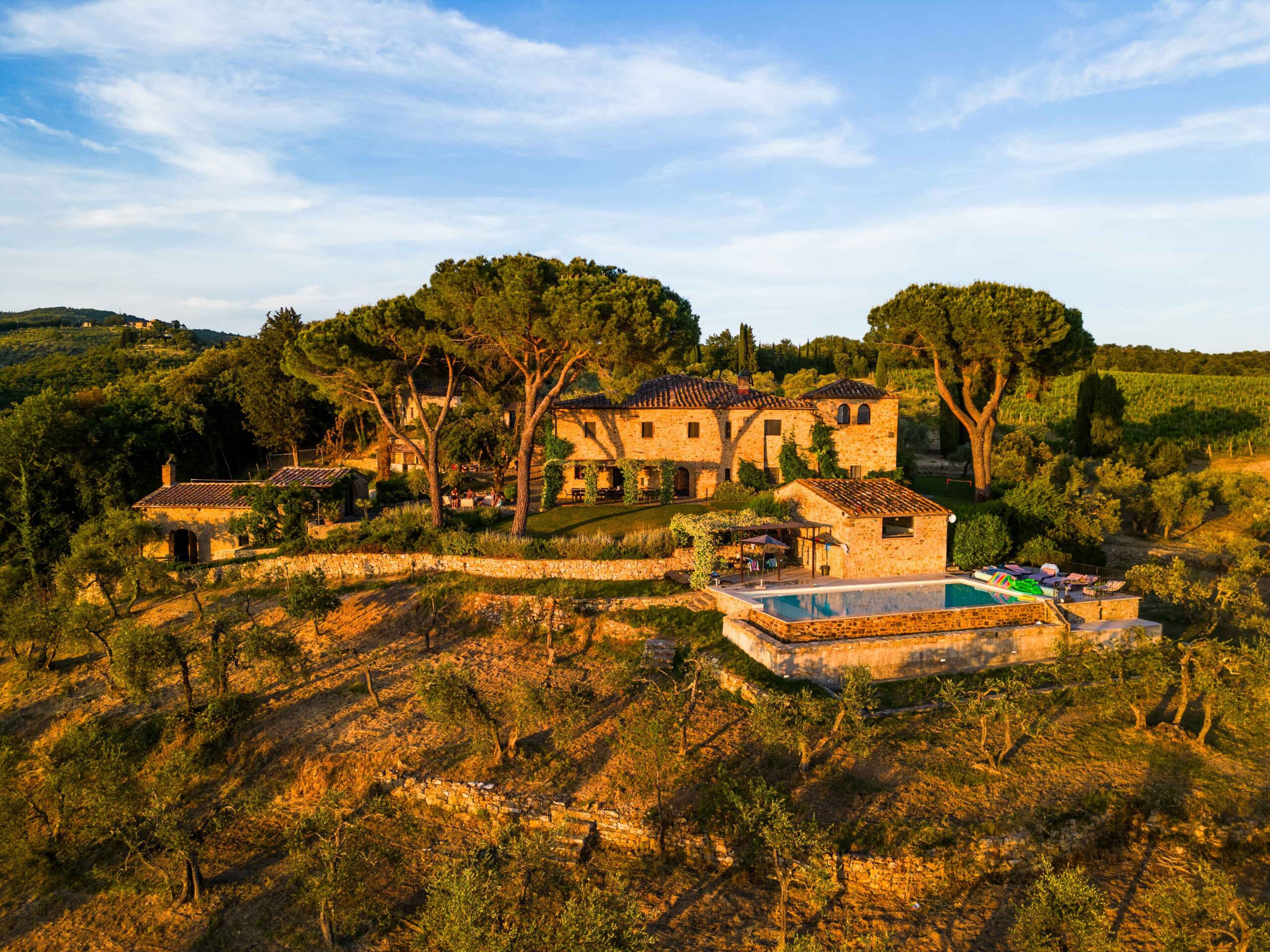
For many travellers, Chianti is the answer to where to stay in Tuscany. This is the Tuscany of imagination — rolling hills south of Florence, cypress-lined lanes, Sangiovese vines and medieval towns like Greve, Panzano and Castellina. Wine lovers should weight the decision heavily toward Chianti: estates here often sit within active vineyards, with private tastings and chef dinners built from the land itself.
Chianti also solves the access half of the decision neatly — it sits in the heart of the region, roughly between Florence and Siena, so day trips in every direction are short. A villa in Tuscany with a vineyard view is most easily found here, and our villas in Chianti range from intimate farmhouses to grand estates. If your ideal where to stay in Tuscany involves a glass of Chianti Classico at golden hour, this is your base. The towns themselves repay slow exploration: Greve in Chianti with its arcaded market square, Panzano and its famous butcher, Radda and Gaiole deeper in the hills, Castellina perched on its ridge. Mornings can be given to a wine estate or a cooking class, afternoons to a hill-town wander or simply the pool, and the whole of the Chianti Classico zone — from Florentine Chianti in the north to the Sienese Chianti in the south — sits within an easy half-hour’s drive. It is the rare base that feels both deeply rural and genuinely central.
Val d’Orcia: the postcard south
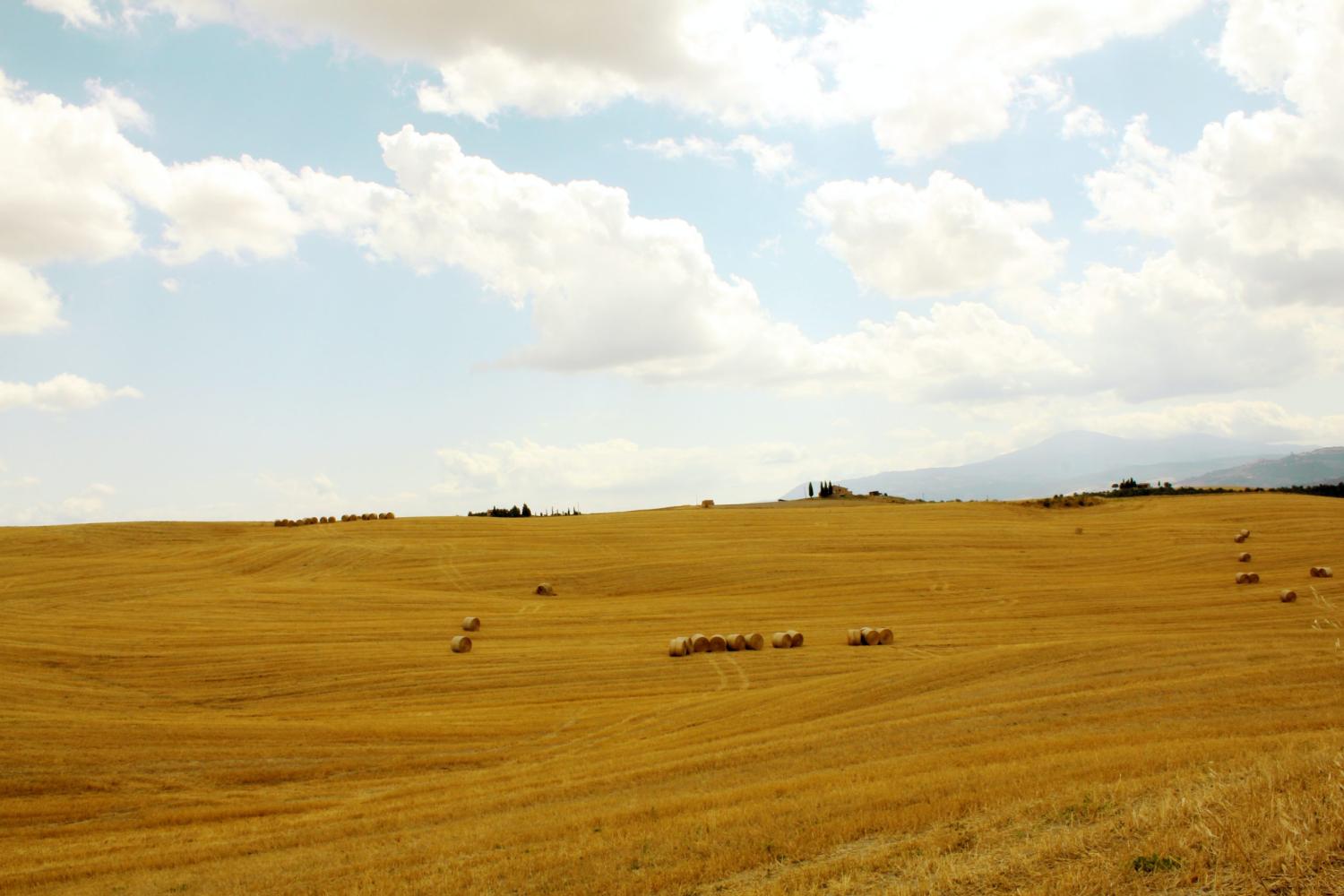
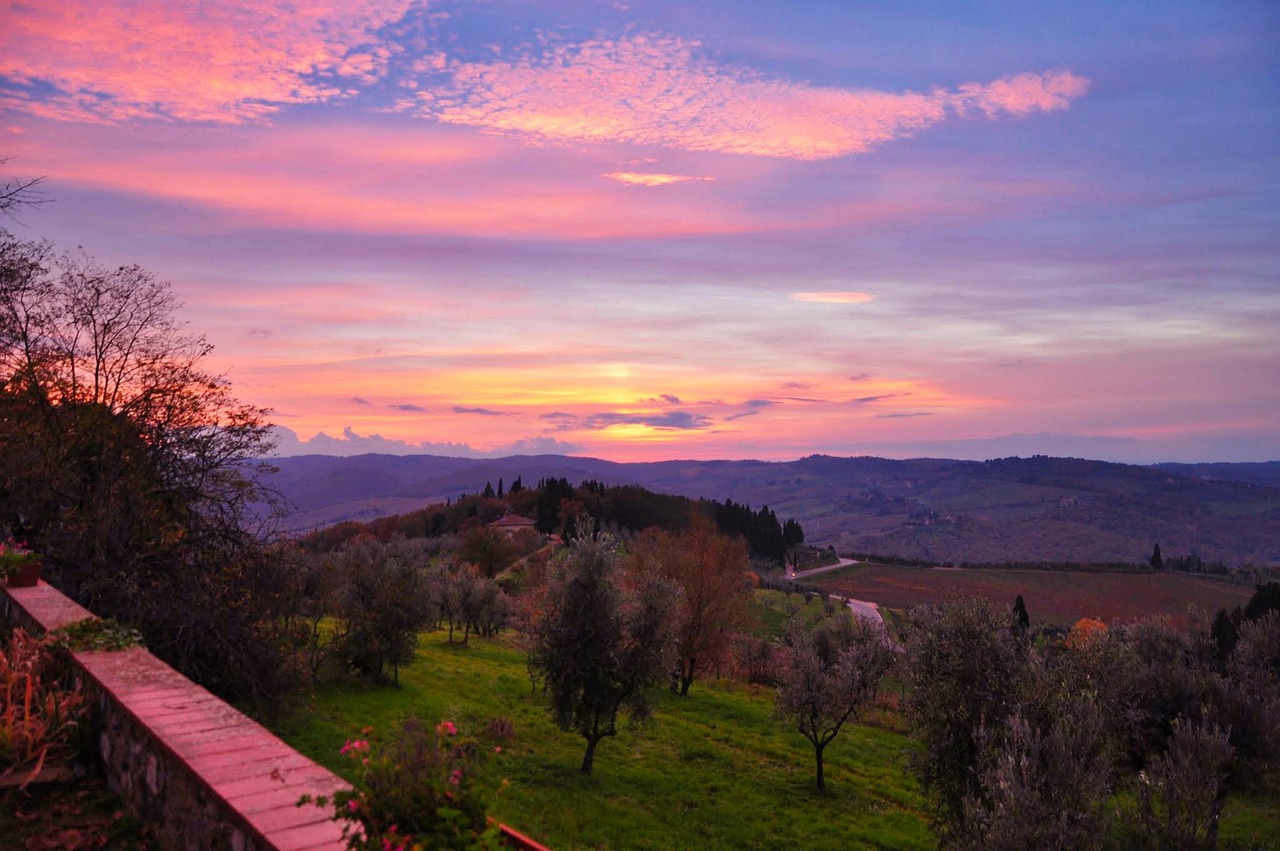
If Chianti is the classic answer to where to stay in Tuscany, the Val d’Orcia is the cinematic one. This UNESCO-listed valley in southern Tuscany — Pienza, Montalcino, San Quirico d’Orcia, the famous cypress stands near San Quirico — is the Tuscany of films and master paintings: golden fields, lone chapels and infinity pools that frame the horizon. Choosing the Val d’Orcia answers where to stay in Tuscany for couples, photographers and anyone chasing absolute calm.
A Val d’Orcia villa typically means more space, more silence and fewer neighbours than Chianti, at the cost of a longer drive to Florence. So if your priority is seclusion and scenery over city access, the south wins. Pair it with Montalcino for Brunello and you have one of the most complete answers to where to stay in Tuscany for a wine-and-quiet week. The valley’s set pieces are unforgettable: the Renaissance perfection of Pienza, the thermal village of Bagno Vignoni with its steaming stone pool at the centre of town, the lone chapel of Vitaleta and the cypress avenues that have become shorthand for Tuscany itself. It is farther from the airport and quieter at night than Chianti — there are fewer towns and they close earlier — but for travellers who want the countryside at its most cinematic and uncrowded, that remoteness is precisely the appeal.
The Tuscan coast: Maremma & Versilia

The sea changes the where to stay in Tuscany conversation entirely. Two coasts compete: the wild, less-touristed Maremma in the south — beaches, pine forests, Etruscan history and horseback country — and the polished Versilia in the north, near Forte dei Marmi, with its beach clubs and chic seaside towns. A Tuscan coast villa suits families who want pool and beach, and travellers for whom where to stay in Tuscany must include swimming in the sea, not just a vineyard view.
The coast is the contrarian answer to where to stay in Tuscany: most visitors default inland, so choosing the Maremma or Versilia buys you a different, breezier summer. The trade is that you’re farther from the Florence–Siena art circuit, so weigh it against how much culture versus coastline you actually want. The Maremma rewards travellers who like their luxury wild — thermal springs at Saturnia, the medieval tufa towns of Pitigliano and Sovana, long undeveloped beaches and some of Tuscany’s best seafood. The Versilia is the opposite register: Forte dei Marmi’s manicured beach clubs, designer boutiques and a marble-mountain backdrop, with Lucca and Pisa close enough for a culture day when the mood strikes. Either coast turns a Tuscan summer into a beach-and-villa hybrid that the inland regions simply can’t offer.
Near Florence & Siena: culture within reach
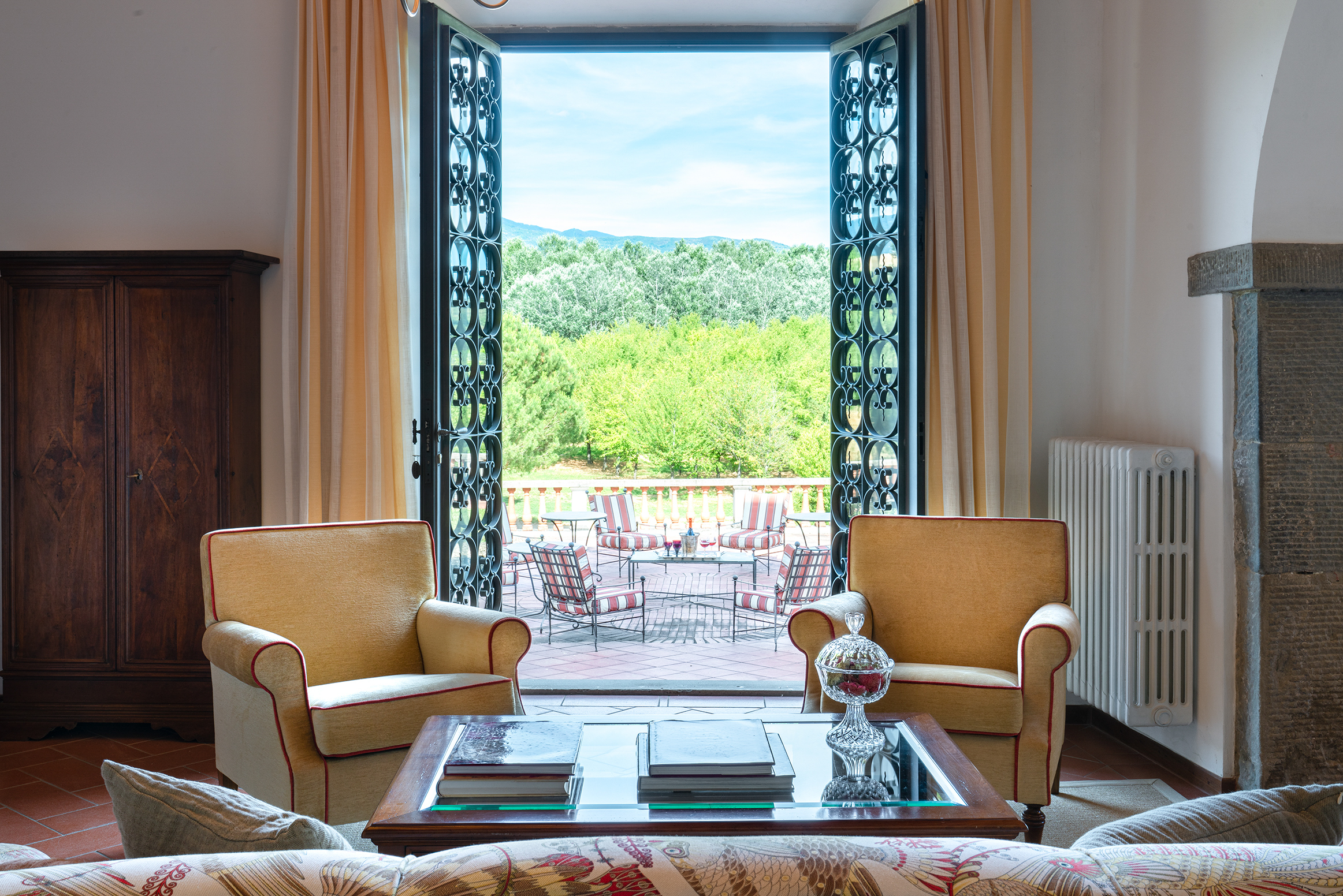
For first-time visitors, the safest answer to where to stay in Tuscany is the culture corridor — the hills around Florence and Siena. Here you can dip into Renaissance art and city life by day, then retreat to a garden and pool by evening. A base among the villas near Florence keeps the Uffizi, the Duomo and Siena’s Piazza del Campo within an easy drive, which is why so many first trips resolve the where to stay in Tuscany question right here.
This is also the most flexible base for mixed groups: culture seekers get their galleries, while the rest get the pool and the pergola. If your party can’t agree on where to stay in Tuscany, the Florence–Siena belt is the diplomatic compromise. From here the greatest hits are all in reach: Florence’s Renaissance core, Siena’s shell-shaped Piazza del Campo, the towers of San Gimignano, the walled calm of Lucca, even a day at the leaning tower of Pisa. Yet step back from the road and the villas here are as rural as anywhere — vineyards, olive groves and pools with long views — so you trade nothing in privacy for the gain in access. For a group that wants to actually see Tuscany’s icons rather than just admire the countryside, this central belt is hard to beat.
Matching the area to your group
The honest version of where to stay in Tuscany depends as much on who is travelling as on scenery.
- Couples — a Val d’Orcia villa for romance and quiet, or a small Chianti farmhouse. For two, choose seclusion over square footage.
- Families — the Florence–Siena belt or a Tuscan coast villa, for the balance of pool, culture and beach. Family travel here rewards short drives and ground-level living.
- Groups of 8+ — Chianti and central Tuscany hold the largest estates; our large villas for groups and reunions cluster here, and the grandest villas in Chianti routinely hold a dozen or more. For an 8+ party, where to stay in Tuscany is partly a function of which villa can actually hold everyone with the grounds to match.
Whatever the group, the underlying head-term question of a Tuscany villa rental is best browsed across the full collection once you’ve narrowed the area.
How many nights, and can you split your stay?
A week is the Tuscan default, and the region rewards it: the whole appeal is the unhurried rhythm, and seven nights in one estate lets a group settle rather than commute. For a first visit, a single central base — Chianti or the Florence–Siena hills — covers the icons without anyone living in the car. Travellers with ten nights or more sometimes split their stay, pairing the classic countryside with a few nights on the coast or in the deep south, which buys real contrast at the cost of a moving day. Beyond Tuscany itself, the region also pairs naturally with Umbria next door or a city finish in Florence or Rome. As a rule, more nights justify more bases; a short week argues for choosing one area well and staying put.
Getting around: airports, drives and day trips
Logistics quietly shape where to stay in Tuscany. Florence (FLR) and Pisa (PSA) are the two main airports; Chianti and the Florence–Siena belt sit within an hour of both, while the Val d’Orcia and the southern Maremma are a longer, scenic drive. A car is essential almost everywhere — part of answering where to stay in Tuscany is accepting that the best estates are rural by design. For a first trip, basing in or near Chianti keeps every classic day trip — Florence, Siena, San Gimignano, the Val d’Orcia — within reach, which is why it remains the most forgiving answer to where to stay in Tuscany.
Experiences that match your base
Your address quietly chooses your week. In Chianti, days bend toward the cellar — private tastings at family estates, a long table under the vines, a sommelier-led drive through Greve and Castellina, perhaps a cooking class with the villa chef using produce from the garden. In the Val d’Orcia, the experiences turn slower and more visual: a sunrise photograph of the cypresses near San Quirico, a Brunello afternoon in Montalcino, a thermal soak at Bagno Vignoni, the kind of day measured in light rather than stops. On the coast, the Maremma offers horseback rides through the macchia, Etruscan ruins and unspoilt beaches, while the Versilia trades in beach-club polish and aperitivo in Forte dei Marmi. Near Florence and Siena, the headline is culture — the Uffizi without the queue, a private viewing, the Palio season in summer — with the villa as a calm retreat at day’s end. None of these is exclusive to one area, but each comes most naturally to its own corner, which is why the base sets the tone.
Best for… at a glance
| Area | Best for | Nearest airport | Typical drive from airport |
|---|---|---|---|
| Chianti | Wine, hill towns, first trips, 8+ estates | Florence (FLR) | ~45–60 min |
| Val d’Orcia | Romance, photography, deep quiet | Florence (FLR) | ~1.5–2 hrs |
| Maremma coast | Beaches, nature, a wilder pace | Pisa (PSA) | ~1.5–2 hrs |
| Versilia coast | Beach clubs, chic seaside towns | Pisa (PSA) | ~45–60 min |
| Florence–Siena belt | Culture, mixed groups, easy access | Florence (FLR) | ~30–60 min |
Summer in Tuscany: heat, crowds and the September window
Season shapes the experience as much as area. July and August are hot and busy, especially around Florence and the headline towns; inland Tuscany runs dry and warm, ideal for pool days but punishing at midday in the open. The coast — Maremma and Versilia — stays a few degrees kinder thanks to the sea breeze, which is part of its summer appeal. Crowds peak in August, when Italians holiday too, so the most sought-after estates are reserved months ahead. The connoisseur’s window is early September: warm days, softer light on the hills, the grape harvest beginning, and noticeably thinner crowds at the galleries and vineyards. If your dates are flexible, shifting a peak-summer trip into the first half of September buys a calmer, more golden version of the same region.
So where should you stay in Tuscany?
If you still can’t decide where to stay in Tuscany, use the breakfast-and-sunset test. Want a vineyard and a long lunch? Chianti. Want silence and a cypress horizon? The Val d’Orcia. Want sand between courses? The coast. Want a museum before your pool? The Florence–Siena belt. For most first trips, the answer to where to stay in Tuscany is Chianti or the central belt — close to everything, classic in every way. For return visits, the question of where to stay in Tuscany usually pulls travellers south to the Val d’Orcia or west to the sea, in search of the quieter, less obvious Tuscany.
Once you’ve settled where to stay in Tuscany, browse the full Italian villa collection to compare specific homes — or let a specialist narrow it for you.
Frequently asked questions
Where should I stay in Tuscany for a first trip?
For a first trip, the safest answer to where to stay in Tuscany is Chianti or the Florence–Siena belt. Both sit centrally, within about an hour of Florence airport, and keep the classic day trips — Florence, Siena, San Gimignano and the Val d’Orcia — within easy reach.
Where is the best area to stay in Tuscany for wine lovers?
Chianti is the classic choice, with estates set among active vineyards and easy access to Chianti Classico tastings. For Brunello, base in the Val d’Orcia near Montalcino. Wine-focused travellers deciding where to stay in Tuscany rarely regret the Chianti hills.
Where should I stay in Tuscany for a quiet, romantic trip?
The Val d’Orcia. It is the most secluded and scenic answer to where to stay in Tuscany — UNESCO-listed countryside, cypress lanes and deep quiet — ideal for couples, at the cost of a longer drive to Florence.
Is the Tuscan coast a good base?
Yes, if swimming in the sea matters to you. The Maremma offers wild beaches and nature; the Versilia near Forte dei Marmi offers beach clubs and chic towns. The coast is a strong, contrarian answer to where to stay in Tuscany for families who want both pool and beach.
Where should a large group of 8 or more stay in Tuscany?
Chianti and central Tuscany hold the largest estates, so for 8+ groups that is usually where to stay in Tuscany. Choose by which villa can comfortably hold the whole party with grounds and pool space to match, rather than by area alone.
Do I need a car to stay in Tuscany?
Almost always, yes. The best villas are rural by design, so wherever you decide where to stay in Tuscany — Chianti, the Val d’Orcia or the coast — plan on renting a car or arranging private transfers.
Request a Tailored Selection
Tell us how you travel — your dates, your group and the kind of Tuscany you’re after — and our Italy specialists will hand-pick a private shortlist across Chianti, the Val d’Orcia, the coast and the Florence–Siena hills, at no cost and with no obligation. Request a tailored selection